
Sound Rules for Strong Markets
- SIFMA Editors
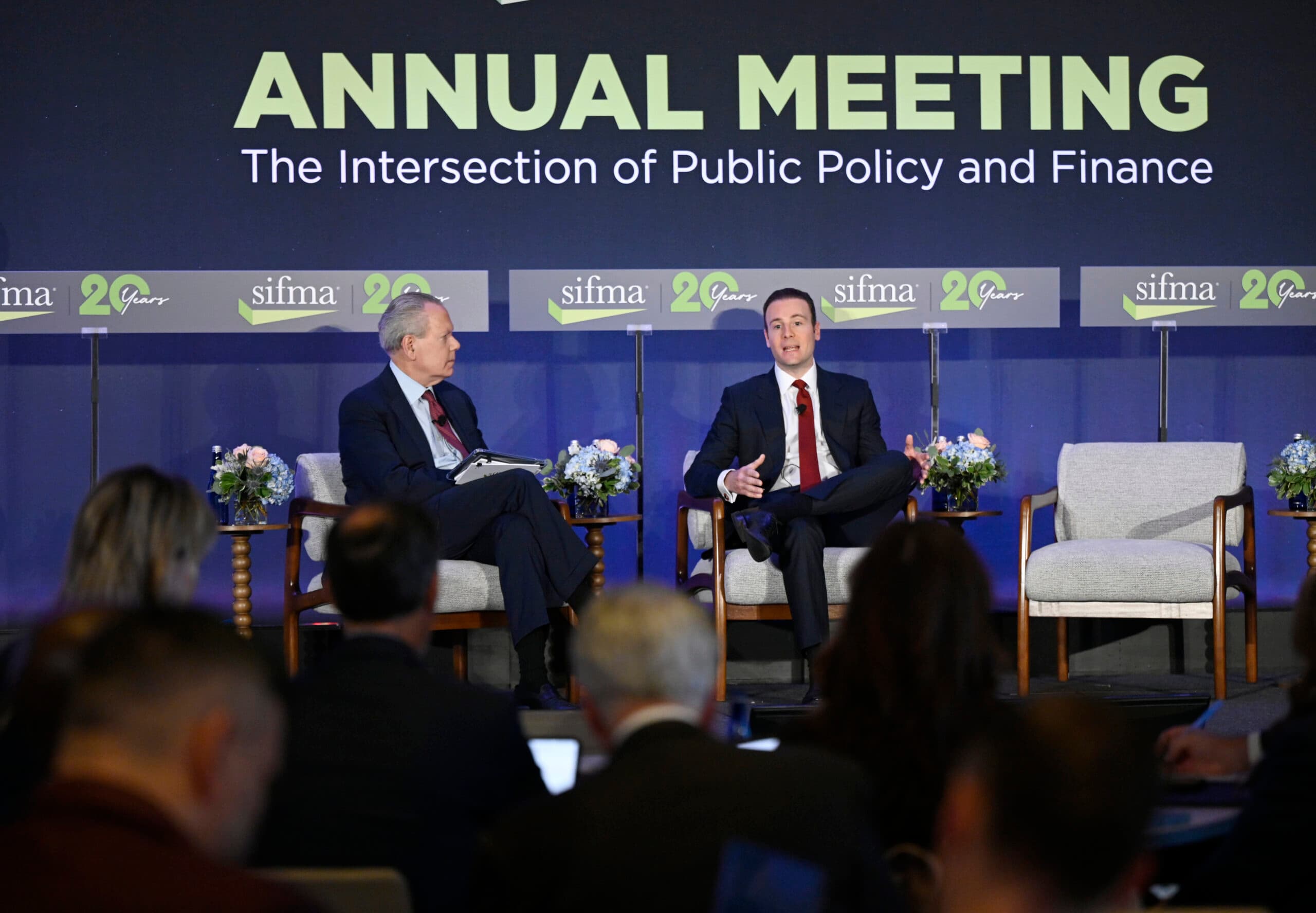
The strength of the U.S. capital markets rests not only on their capacity to innovate, but on the investor confidence, market integrity and resilience supported by sound regulation.
As markets evolve, that regulatory framework must continue to evolve as well.
That theme ran through conversations with CFTC Chairman Michael S. Selig and SEC leaders Jamie Selway and Sebastian Gomez Abero at SIFMA’s 2026 Annual Meeting. From tokenization and new derivatives products to extended trading, equity market structure, capital formation and Treasury clearing, regulators are confronting a broad modernization agenda — and a common challenge: how to preserve the protections that underpin U.S. market strength while ensuring the regulatory framework encourages innovation and U.S. competitiveness.
Creating room for responsible innovation
Chairman Selig described markets being transformed by blockchain, artificial intelligence and new products including perpetual contracts and prediction markets — with some innovation occurring offshore or outside traditional market structures.
For U.S. markets, he said, the objective is to create a path for promising ideas here at home while ensuring that innovation develops within an appropriate regulatory framework.
Drawing on an observation that perhaps 99% of new ideas may not work but 1% could prove particularly valuable, Selig said the United States needs to “create a path for that” while leading in “responsible innovation” with appropriate rules and guardrails.
That includes assessing which existing rules continue to serve an important purpose and where requirements can be right-sized as markets change. At the same time, Selig emphasized that new markets need rules designed for the activity taking place. In discussing crypto markets, for example, he called for “market-based regulation” appropriate to platforms that custody and trade assets rather than frameworks originally designed for payment services.
The underlying principle is not less regulation. It is regulation calibrated to the risks, activities and markets it is designed to address.
Coordination matters as product lines blur
New products increasingly cross traditional regulatory boundaries.
Selig described close coordination between the CFTC and SEC on product classification, cross-margining and areas where similar products may fall within different statutory frameworks. That work is part of the agencies’ broader SEC-CFTC Harmonization Initiative, designed to reduce duplicative requirements, clarify jurisdictional boundaries and create pathways for new products while maintaining investor and market protections.
The agencies’ coordination is already being tested as existing products return in new forms. With renewed interest in single-stock futures and the emergence of perpetual futures on securities, Selway said the SEC is working closely with the CFTC, FINRA, and NFA to develop an appropriate monitoring framework.
The products may offer useful innovation. Giving them an opportunity to develop, Selway said, also requires ensuring investor protection remains central.
Balance is especially important as innovation changes not only products but the structures in which they trade.

SIFMA’s Ken Bentsen in conversation with the SEC’s Sebastian Gomez Abero and Jamie Selway
Experimentation with existing protections
The SEC’s approach to tokenized securities offered another example of regulation evolving alongside innovation.
Selway described the Commission’s innovation exemption as a measured way to introduce tokenized securities into the U.S. capital markets, learn from actual market activity and use that experience to inform permanent rules.
“We want to do something exemptive, collect data, see how the market reacts, and then head to formal rulemaking,” he said.
SIFMA has emphasized the importance of getting that experimentation right from the outset. In an October 19 comment letter, SIFMA urged the SEC to resolve key questions around issuer notice and consent, investor protection and oversight, trading-volume limits, beneficial ownership and corporate actions as tokenized securities venues begin operating.
Many existing investor protections continue to apply, including trading halts, anti-fraud, and anti-manipulation requirements and applicable broker-dealer best-execution obligations. The framework also gives issuers a role in determining whether their securities participate.
Gomez noted that an issuer receiving notice can object, select one tokenized securities venue but not another, or engage with a venue before making a decision. He also emphasized that the exemption does not eliminate existing shareholder-communication or corporate-action requirements.
Industry panelists earlier in the day also highlighted why monitoring the experiment matters. Eddie Wen of JPMorganChase cautioned that liquidity can migrate toward channels operating under fewer restrictions, potentially producing unintended market-structure effects. The challenge is to allow experimentation without allowing an exemption designed as a pilot to reshape the broader market in unintended ways.
The approach reflects a broader theme from the Annual Meeting: experimentation and investor protection need not be opposing goals. Carefully structured pilots can help regulators and market participants understand how new models perform before determining what a durable framework should look like.
Those same questions — what delivers meaningful benefits, what can scale and which guardrails work — also ran through the industry discussion of AI, tokenization and market infrastructure. They are explored further in Exploring the Next Era of Markets: The Innovation Outlook at SIFMA’s 2026 Annual Meeting.
Modernizing the public-market framework
At the SEC, modernization is also focused on the environment companies face when deciding whether to enter — and remain in — the public markets.
Gomez noted that regulators do not control every factor influencing a company’s decision to go public. They do, however, influence the regulatory landscape those companies encounter.
He described an effort to refocus disclosure requirements around financial materiality and examine requirements throughout the lifecycle of a public company — from the IPO process to the disclosures and capital needs that continue afterward.

Sebastian Gomez Abero, U.S. Securities and Exchange Commission
That includes proposals to simplify issuer categories and extend certain accommodations to more mid-size and smaller public companies while maintaining protections where the greatest share of public-market investment resides. It also includes efforts to make it easier for newly public companies to return to the markets for additional capital rather than effectively repeating much of the IPO process.
The broader objective is important: capital formation and investor protection should reinforce one another. Public markets need to be attractive enough for companies to enter and remain in them, while investors need confidence in the information, protection, and integrity those markets provide.
SIFMA has examined that challenge in depth, including the long-term decline in the number of U.S. public companies and policy reforms that can help make going — and staying — public more attractive.
Market structure must keep pace
The same modernization question applies to the mechanics of trading.
Selway discussed the SEC’s work around equity market structure, including proposed changes involving Rule 611 and the need to consider those changes alongside modernization of best execution.
Best execution, he noted, increasingly has to account for developments such as overnight trading and tokenization — changes that were not contemplated in the same way when today’s market-structure rules were developed.

Jamie Selway, U.S. Securities and Exchange Commission
Extended trading raises its own implementation questions. As U.S. equities move toward longer trading hours, regulators and the industry must work through issues including corporate actions, price protections and the infrastructure needed to support trading outside traditional hours. Selway said the direction is clear even if the ultimate level of overnight demand remains uncertain.
Those questions will continue at SIFMA’s Market Structure Conference on November 17–18 in New York, which will bring together market participants and regulators to examine regulation, technology and evolving trading paradigms across equities and options.
Treasury clearing: from preparation to implementation
Treasury clearing represents another — and particularly consequential — example of the importance of implementation.
The SEC’s central-clearing rule represents one of the most significant structural changes to the U.S. Treasury market in decades, with implications across broker-dealers, institutional investors, trading firms, clearing agencies and market infrastructure.
The phased compliance dates are December 31, 2026, for in-scope Treasury cash transactions and June 30, 2027, for in-scope repo transactions.
Asked about implementation, Selway was clear on the approaching first phase: “We feel very good about cash.” He described repo as the more complex part of implementation and noted the continuing work among regulators and market participants to address issues as that deadline approaches.
That distinction is also visible in SIFMA’s latest industry data. A September pulse survey of 340 market experts found broad readiness for the December cash implementation, while identifying additional operational, technology, documentation and regulatory work as the industry moves toward the June repo deadline. Eighty-six percent of respondents were at least somewhat confident in meeting the overall mandate.
The focus now is disciplined execution: completing the work necessary for a smooth cash implementation on December 31 while continuing to advance the more complex preparations required for repo in 2027.
The Treasury market also featured prominently in the Annual Meeting’s economic discussion, where speakers examined interest rates, bond yields and fiscal risks against the backdrop of an otherwise resilient economy. That broader context is explored in Growth, Rates, and Risks Ahead: The Economic Outlook at SIFMA’s 2026 Annual Meeting.
Strong markets require both innovation and trust
The United States begins from an enviable position: deep and liquid markets, significant investor participation, strong institutions and a regulatory framework that has helped support confidence and resilience.
Preserving that position does not mean preserving every rule unchanged.
As technology, products and market structures evolve, effective regulation must distinguish between protections that remain fundamental and requirements that need to be reconsidered, modernized or applied differently. It must provide clarity for firms developing new products, coordination where regulatory jurisdictions intersect, opportunities to learn through controlled experimentation, and strong guardrails where investor and market risks remain.
Sound regulation has long been part of the foundation of U.S. capital-market leadership. Getting the next generation of rules right will be essential to maintaining it.