
Exploring the Next Era of Markets
- SIFMA Editors
The challenge of innovation is not new to the capital markets. For decades, financial institutions have adopted technologies that expanded access, increased efficiency and changed how clients are served — while protecting assets, maintaining market integrity and preserving the trust on which the markets depend.
What is changing is the pace and convergence of that innovation.
At SIFMA’s 2026 Annual Meeting, industry leaders explored a financial system being reshaped by artificial intelligence, tokenization, extended trading, new products and changing models of distribution. The focus was not simply on what technology can make possible, but on which innovations can deliver meaningful benefits to investors and markets — and how firms can integrate them while maintaining security, resilience, investor protection and trust.
That exploration starts from a position of strength.
“The markets are vibrant,” said David Lefkowitz, 2026–2027 Chair of the SIFMA Board of Directors. He pointed to new technologies and products emerging in deep, liquid capital markets supported by strong investor protections. The challenge, he said, is to preserve those strengths as new ideas move from something novel into “part of the fabric of the markets.”

David Lefkowitz, JPMorganChase
From experimentation to outcomes
The distinction between experimentation and durable market change ran throughout the Annual Meeting.
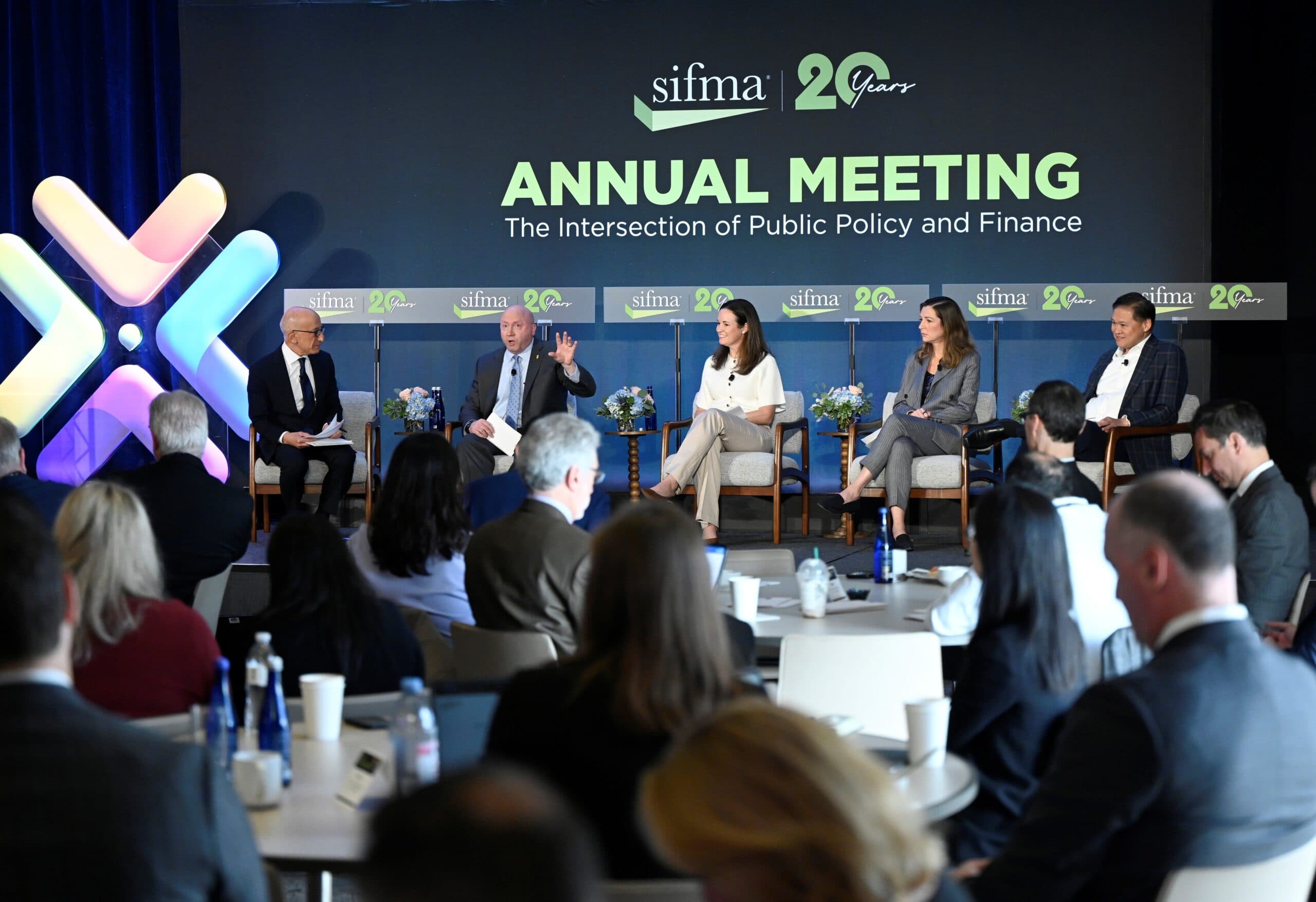
During the Future of Finance panel moderated by former CFTC Chairman Timothy Massad, leaders from BlackRock, JPMorganChase, Morgan Stanley and Robinhood examined what developments in AI, tokenization and market infrastructure could mean in practice.
AI is already changing how firms organize and analyze information, serve clients and build products. Increasingly sophisticated tools can also give investors greater ability to compare fees, evaluate risks and returns, scrutinize products and services, and bring more information and analysis directly into their decision-making.
Tokenization raises a similarly consequential set of questions. The technology could improve collateral mobility, treasury management, settlement and access to financial products. But panelists cautioned that success should not be measured simply by how many tokenized securities trade or how quickly adoption grows.
Jessica Hartnett of BlackRock framed the more important test: “What are the net benefits? What are the actual outcomes that are coming as a result of this experimentation?” She also pointed to the opportunity to learn which guardrails work in controlled pilots and could ultimately scale more broadly.
That is an important distinction. Innovation in one part of the market affects many others. Extended trading, for example, requires more than keeping a trading venue open longer. Funding, collateral, clearing, settlement, corporate actions and operational support all must function alongside it.
The next era of finance will therefore be defined as much by orchestration as invention. New products, trading infrastructure, operations, risk management, cybersecurity and regulation all must work together. A breakthrough in one layer cannot deliver its full value if the rest of the market ecosystem cannot support it.
That orchestration includes the regulatory framework. In his Annual Meeting conversation, CFTC Chairman Michael S. Selig argued that the United States needs to create a path for the ideas that work — while leading in both innovation and responsible innovation, with appropriate rules and guardrails.
That balance between experimentation and strong market foundations is explored further in Sound Rules for Strong Markets: The Regulatory Outlook at SIFMA’s 2026 Annual Meeting.
Trust becomes more even important
As technology becomes more capable, trust becomes even more important.
Amy Oldenburg of Morgan Stanley noted that investors will continue choosing firms, advisors and platforms in part because they trust them to protect their assets and financial future. That responsibility becomes more complex as technology is embedded more deeply into the financial product itself.
“When the actual financial product becomes the technology,” she said, a security compromise can have immediate consequences.
That changes how firms need to think about product development. Oldenburg argued that technology and operations teams need to be in the first conversation when products are designed. Firms that integrate operational expertise from the start can build resilience into the product itself, turning what was once viewed primarily as a support function into a strategic capability.

Amy Oldenburg, Morgan Stanely
Hartnett raised a related investor-protection challenge: as new models emerge, investors need to understand exactly what they own. With a tokenized security, for example, questions around shareholder status, voting rights, dividends and counterparty exposure can directly affect investor confidence.
Cybersecurity sits underneath all of it. Eddie Wen of JPMorganChase warned that a cyber event affecting ownership or critical market infrastructure could have consequences far beyond a traditional data breach. Cybersecurity, he said, is not a “nice to have”; it must become an inherent part of the business model.
Tim Gokey, CEO of Broadridge, made a related point later in the program. As firms develop hybrid infrastructures spanning traditional and tokenized assets, the goal should be to build on controls that already work while creating a trusted and resilient infrastructure for what comes next. He also pointed to agentic AI as a potential way to absorb greater operational scale and complexity — provided accountability and control remain intact.
More information — and continued need for advice
For all the discussion of transformation, some of the most revealing moments focused on what technology will not replace.
Ronald J. Kruszewski, 2025–2026 Chair of the SIFMA Board of Directors, reflected on nearly 45 years in the business. When he began, financial firms controlled much of the information investors needed and even basic market prices required a phone call. Today, information and trading are broadly accessible.
What has endured, he said, is the need for judgment and advice.
“The more information becomes accessible, frankly, the more need there is for advice.”

SIFMA president and CEO Ken Bentsen in conversation with Stifel CEO Ron Kruszewski
Kruszewski connected that point to SIFMA’s 2026 VISTA investor research, which showed high overall investor satisfaction alongside continued interest in trusted guidance as new investment choices emerge.
The Future of Finance panel arrived at a similar conclusion when Massad asked what would not change when the group reconvenes five years from now, at the 2031 Annual Meeting. Matt Billings of Robinhood answered simply: “the handshake” — shorthand for the human relationships, collaboration and trust that remain at the center of financial services.
Asked what might change, the panel envisioned significantly broader investor participation — a welcome development if innovation can continue expanding access to the markets. They also forecast a world in which financial products are available in more places and through new distribution models, with embedded finance changing how investors encounter and use financial services.
At the same time, panelists acknowledged that technological disruption and cyber risk could create new challenges for policymakers, firms and investor confidence.
The direction of travel is clear: technology will continue to change how markets operate, how products are built and how investors participate.
But the next era of markets will not be defined by technology alone. It will depend on whether innovation solves real problems, whether the many parts of the financial system can evolve together, and whether change strengthens rather than fragments market infrastructure while preserving the security, resilience and trust on which the U.S. capital markets are built.