
Growth, Rates, and Risks Ahead
- SIFMA Editors
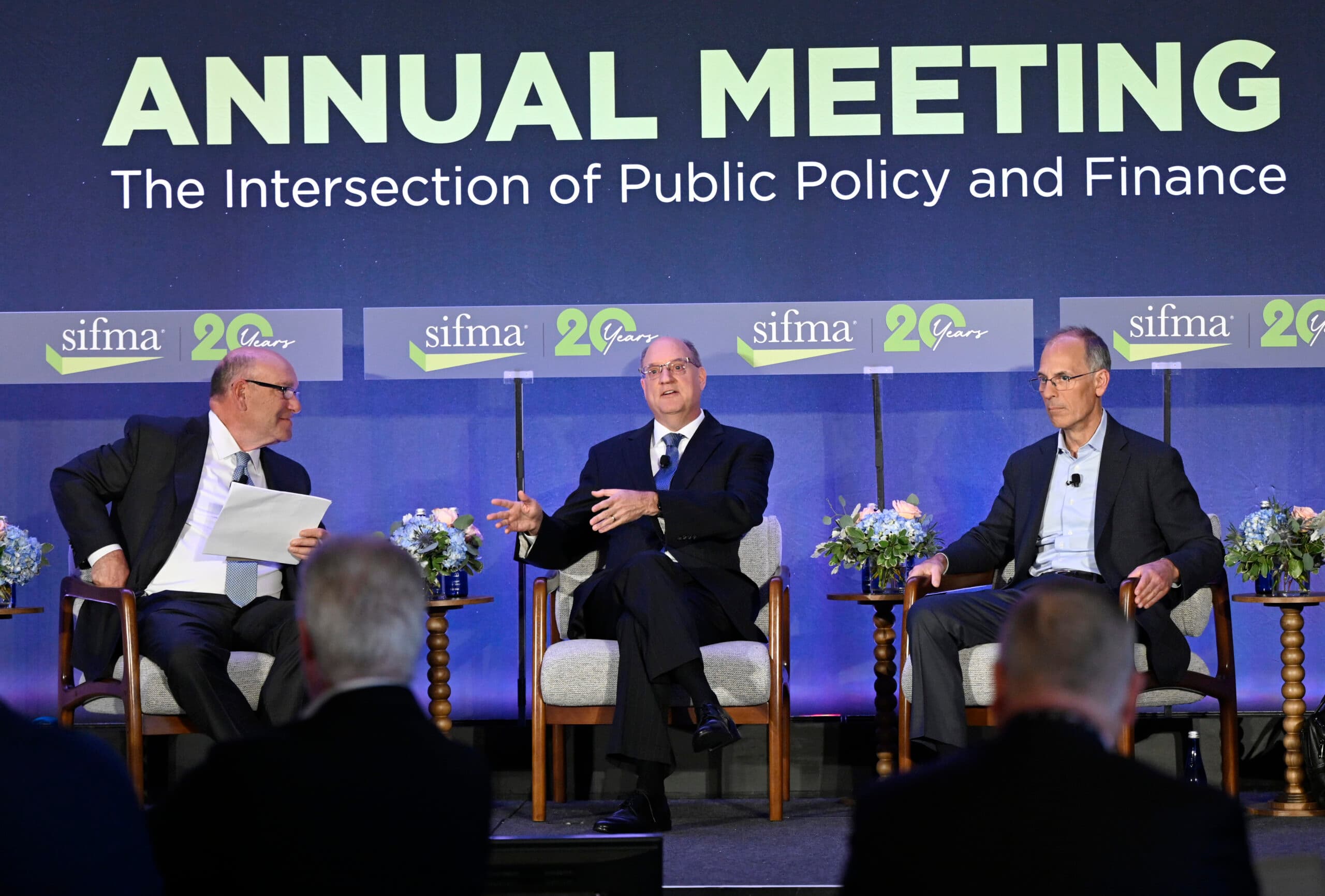
Is the U.S. economy showing remarkable resilience — or are risks beneath the surface beginning to build?
At SIFMA’s 2026 Annual Meeting, the answer was, in many respects, both.
In a wide-ranging conversation moderated by CNBC’s Steve Liesman, BMO Chief U.S. Economist Scott Anderson and Moody’s Analytics Chief Economist Mark Zandi debated growth, inflation, Federal Reserve policy, the AI investment boom and the vulnerabilities created by elevated interest rates.
Their forecasts were not dramatically different. Their assessment of the risks was.
Resilient growth — but not evenly distributed
Anderson described the story of 2026 as one of “robust, resilient growth,” pointing to stronger-than-expected economic activity, consumer spending, corporate profitability and capital investment.
Zandi saw a more divided picture.
For households and businesses tied to the AI ecosystem, he said, conditions can look exceptionally strong: capital spending is booming, profits are healthy and rising equity values have created significant wealth. Outside that ecosystem, however, slower hiring, softer wage growth and higher costs are creating a different experience.
Looking only at the averages can obscure what Zandi described as “two different worlds” underneath the economy. Anderson agreed that the gains have not been spread evenly, even as he maintained a more optimistic view of overall growth.
That tension — strong aggregate data alongside meaningful pressure in parts of the economy — shaped much of the discussion.

Mark Zandi, Moody’s
Inflation and the higher-for-longer question
The economists also differed over the persistence of inflation and the appropriate path for monetary policy.
Anderson argued that continued price pressures could require additional tightening. Zandi was more skeptical that current inflation would broaden into the kind of persistent dynamic that would require significantly tighter monetary policy, and warned about the risks of weakening demand unnecessarily.
By the time Liesman asked for their 2027 growth forecasts, however, the headline numbers were relatively close. Zandi projected 1.9% GDP growth on a fourth-quarter-to-fourth-quarter basis for 2027; Anderson put his forecast at 2.2%.
Zandi argued that the more important disagreement was not the central forecast itself, but “the distribution of possible risks and what that means for the appropriate conduct of policy.”
That distinction matters in an economy facing materially higher borrowing costs.
The panel dissected the rise in Treasury yields. Anderson attributed much of the increase to changing expectations for Federal Reserve policy, with an additional term-premium component reflecting concerns about federal debt and deficits. Zandi placed greater weight on supply shocks and the resulting change in inflation and rate expectations.
Different explanations led to a similar practical question: What happens if rates stay elevated for longer than borrowers, investors and businesses had expected?
Financing costs are beginning to matter
Higher financing costs can affect housing, commercial real estate, autos, small businesses and leveraged private-market transactions.
Zandi pointed to borrowers and sponsors that had extended maturities in anticipation of eventually refinancing at lower rates — a strategy that becomes considerably more difficult if borrowing costs remain elevated.
Anderson agreed that “financing costs could be the catalyst,” particularly as tighter credit flows through interest-rate-sensitive areas of the economy. He pointed to housing, commercial real estate, autos and small businesses among the areas likely to feel the effects.

Scott Anderson, BMO
Household credit, however, was not at the top of Zandi’s risk list. He described overall consumer-credit growth as relatively modest and delinquencies as somewhat elevated from pre-pandemic levels but broadly stable, while identifying pockets — including certain mortgage borrowers — that warrant attention in a higher-rate environment.
The AI boom: growth engine and concentration risk
No economic discussion in 2026 can avoid the scale of investment flowing into artificial intelligence.
Liesman characterized the current environment as potentially “the biggest capital investment boom in maybe the history of mankind.” The spending is supporting growth and productivity expectations, but the panel also examined whether the economy is becoming too dependent on a relatively small group of companies and investment themes.
Liesman has also examined the labor-market side of that transformation, looking at what earlier waves of automation can tell us about how AI may reshape jobs and the workforce.

Steve Liesman, CNBC
Anderson pointed to the narrowness of some of the expansion: AI investment has supported equity wealth, which in turn has helped consumer spending. A significant disruption to that cycle could therefore travel beyond the technology sector.
Zandi likewise argued that rapid credit growth around any new investment boom deserves scrutiny, even if current debt levels do not yet appear systemic.
At the same time, the long-term economic potential could be significant. Zandi said he expects AI to increase total factor productivity growth by roughly half a percentage point annually over the next decade — provided the benefits are distributed broadly.
AI’s implications extend well beyond the macroeconomy. The same technology is reshaping financial products, operations, advice and market infrastructure — questions explored further in Exploring the Next Era of Markets: The Innovation Outlook at SIFMA’s 2026 Annual Meeting.
A 2027 risk to watch: the debt ceiling
One of the sharpest warnings of the session concerned the Treasury market.
Zandi identified the need to raise the federal debt limit in 2027 as a significant risk, particularly against the backdrop of an already sensitive bond market. Repeated debt-limit confrontations, he argued, have brought policymakers increasingly close to the so-called X date, raising the risk of a mistake.
His concern was not simply political uncertainty. Zandi pointed to a Treasury market in which ownership has shifted away from some traditionally price-insensitive buyers, including the Federal Reserve and foreign central banks, toward more price-sensitive participants such as hedge funds engaged in leveraged basis trades.
Those firms play an important role in providing liquidity, he noted, but the change in market structure can also create vulnerabilities under stress.
Against that backdrop, Zandi said “one of the most significant threats to 2027 is much higher bond yields,” with a debt-limit confrontation a potential catalyst. Anderson agreed that the debt ceiling will be an issue for markets next year.
The Treasury market is also undergoing one of its most significant structural changes in decades as the industry implements expanded central clearing. The regulatory and market-structure implications of that transition are explored further in Sound Rules for Strong Markets: The Regulatory Outlook at SIFMA’s 2026 Annual Meeting.
Resilience does not eliminate risk
The economic conversation at Annual Meeting did not produce a simple bull-or-bear conclusion.
Growth has been more resilient than many expected. Investment is strong. Corporate profits and new technologies continue to provide important support.
At the same time, inflation remains a challenge, borrowing costs are elevated, financing pressures are working their way through the economy and risks are accumulating in areas that may not yet be fully visible.
Perhaps the clearest takeaway is that those realities can coexist.
The U.S. economy can remain resilient while becoming more sensitive to shocks. And as 2027 approaches, the interaction among growth, inflation, interest rates, financial markets and fiscal policy may matter as much as any single forecast.