
The Investor of Tomorrow
- Randy Snook
By Randy Snook
There’s little question that the forces of technology, interconnectedness and generational change have challenged the conventional wisdom about investors and financial advice. But how should institutions go about investing in new capabilities in a way that complements and supports their business’s traditional strengths?
As participants at SIFMA’s 2015 Annual Meeting, The Capital Markets Conference, were quick to point out, digital disruption has left no shortage of industries to look toward as case studies. “If you think about the way we behave in every other part of our lives: Amazon is the largest retailer in the world; Uber is the largest transportation company,” said Wells Fargo Advisors president Mary Mack. “We behave differently now in terms of how we like to access information and advice.”
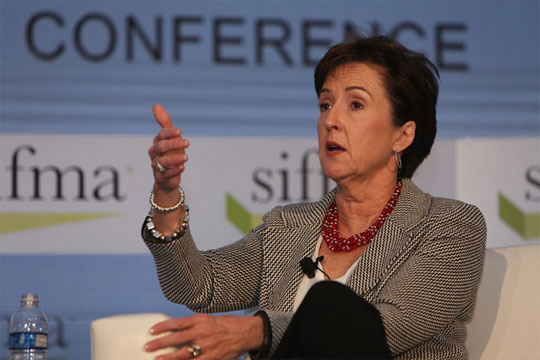
Mack noted there are plenty of analogies to financial services. “If you are sick, do you go to a doctor first? No. You go to WebMD,” she said. “And then, in a panicked state, you go to a professional.”
Of course, nowhere are these trends more pronounced than with millennials, who financial professionals rightly recognize are important to connect with early so that they can be readily called upon at important milestones.
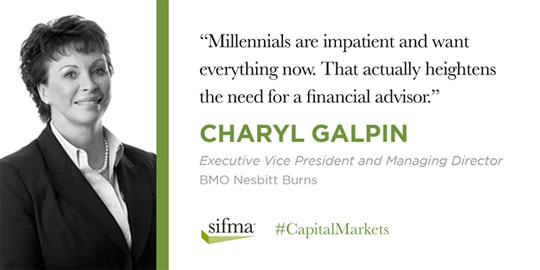
“Millennials are impatient and want everything now,” said Charyl Galpin, Managing Director and head of the Private Client Division at BMO Nesbitt Burns. “That actually heightens the need for a financial advisor … We think 90% of them should have a plan, but only 30% of them do.”
When it comes to the basics, however, millennials aren’t necessarily much different from other investors. “Millennials don’t look at things differently. They want to understand what it’s going to take. They have goals – they’re goals-driven. They primarily differ in how they want to engage,” said Lisa Kidd Hunt, Executive Vice President at Charles Schwab. “Millennials are well-informed, but they recognize expertise when they see it. And they respect it,” added Kevin Alm, a principal with Edward Jones’ Client Strategies Group.
Still, those differences in how millennials – and increasingly, many older investors – want to engage aren’t insignificant. Knowing how and where to invest in these capabilities can be daunting for many firms. “We think about technology in two ways,” said Hunt. “One is simplicity – making it simple to use technology, to stay connected, to get what you want, when you want it. And the other is choice … when you want to work with us and where.”
With the rapid pace of technological change, it most important to remember that technology is an amplifier to what financial advisors do, not a replacement. “For most clients, it’s a spectrum,” said Hunt. “It doesn’t displace human contact and face-to-face. But it enables them to engage with us on the phone, in a mobile environment.”
We have to engage clients in a variety of ways – regular, proactive contact needed via technology #CapitalMarketspic.twitter.com/7BUP1MYCDW
— Gary Liu (@garycliu) November 10, 2015
Galpin agreed, noting that technology can strengthen a financial advisor’s core value proposition in a world with competing pressures for time and attention. “Our business is steeped in deep, personal relationships,” she said. “Consistent, regular communication is essential.”
Randy Snook
Executive Vice President, Head of Business Policy and Practices
SIFMA