Protecting the Financial System: Highlights from SIFMA’s 26th Annual AML Conference
Key Takeaways
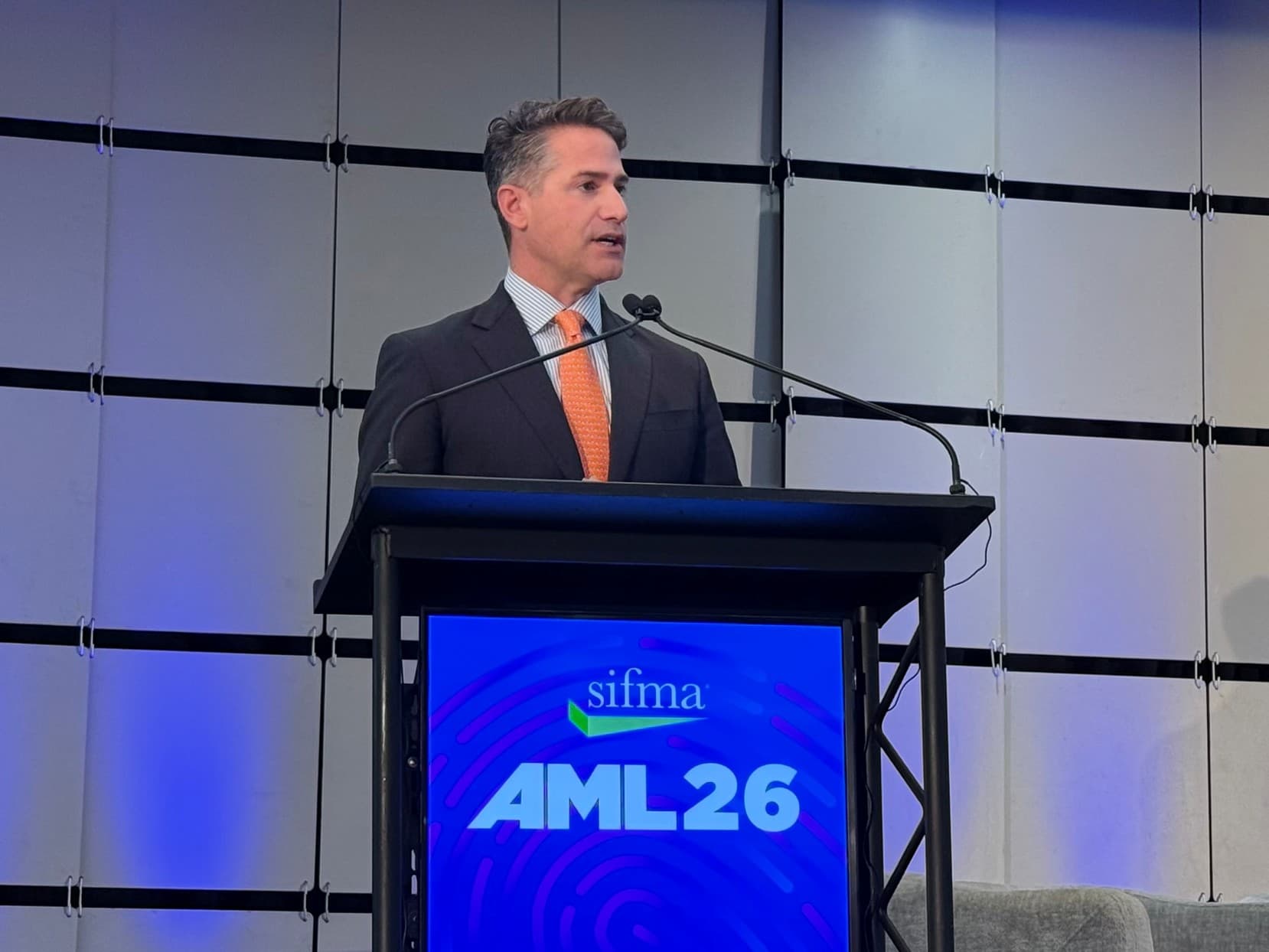
- SIFMA’s 26th Annual AML Conference brought together industry leaders to address the most pressing issues in financial crimes compliance. Key focus areas included AML Act implementation, sanctions reform, the intersection of AML and digital assets, and how the industry can improve collaboration and information sharing to address illicit finance.
- SDNY U.S. Attorney Jay Clayton discussed the importance of disrupting illicit money flows to combat terrorism and trafficking and called for greater data sharing between law enforcement and the financial sector to detect activity. He also addressed SDNY’s application of existing insider trading and manipulation laws to crypto and prediction markets and encouraged firms to self-report fraud and misconduct — indicating that those who come forward will be welcomed as partners.
- Acting U.S. Treasury Undersecretary Gene Lange outlined the Administration’s AML reform priorities, centered on the principle that economic security is national security. Key themes included BSA modernization and a more risk-oriented examination approach, targeted sanctions reform, and Treasury’s forward-leaning posture on AI.
- Operation Shamrock founder Erin West sounded the alarm on transnational organized-crime fraud and scams such as pig butchering, a scheme that combines fictitious online relationships with fraudulent cryptocurrency investment platforms to drain victims’ savings. West called on the financial services industry, law enforcement, and international partners to improve collaboration and intelligence sharing to collectively address this rapidly expanding threat.
SIFMA’s 26th Annual Anti-Money Laundering and Financial Crimes Conference (SIFMA AML) brought together industry professionals, regulators, policymakers, and law enforcement officials for two days of substantive dialogue on the most pressing issues in AML and financial crimes compliance. The financial crimes landscape continues to evolve rapidly — with increasingly sophisticated fraud schemes, emerging technologies, geopolitical risks, and new business models creating an increasingly complex operating environment for firms.
SIFMA remains actively engaged on behalf of our members across a broad range of AML, illicit finance, and financial crimes issues:
- Sanctions reform: In April, SIFMA released a white paper prepared by SIFMA’s Anti-Money Laundering and Financial Crimes Committee and Sanctions Working Group, with assistance from Debevoise & Plimpton. The paper highlights how the rapid expansion of sanctions affecting capital markets activities since 2014 has created a patchwork of compliance obligations that often do not reflect how modern securities markets function and, in some cases, have resulted in unintended harms to U.S. investors. The paper calls for a standardized capital markets sanctions framework and greater flexibility for investors to divest sanctioned securities.
- AML Act implementation: SIFMA continues to support implementation of the Anti-Money Laundering Act of 2020, engaging with the Treasury, FinCEN, the SEC, and FINRA to ensure the Act is implemented consistently with its modernization objectives. SIFMA has also remained closely engaged on FinCEN’s Investment Adviser AML program rule, encouraging FinCEN to revise it to be better tailored.
- AML and digital assets: As firms expand into digital assets and other new products, AML and financial crimes programs must adapt. New tools are already transforming surveillance, monitoring, investigations, and fraud prevention — strengthening compliance capabilities while complimenting the expertise and judgement of professionals in the field.
- Collaboration and information sharing: Through SIFMA’s committees, working groups, roundtables, and ongoing engagement efforts, SIFMA continues to foster collaboration and support members as they navigate an increasingly complex financial crimes landscape.
This year’s program featured three keynote sessions spanning law enforcement priorities, administration policy, and fraud prevention.
U.S. Attorney for the Southern District of New York (SDNY) Jay Clayton on AML and Financial Crimes Enforcement Priorities
SDNY U.S. Attorney Jay Clayton joined SIFMA President and CEO Ken Bentsen for a fireside chat on enforcement priorities, AML modernization, and the evolving landscape of financial crime. Here were some key takeaways from their discussion:
- Combating illicit finance: Clayton noted that disrupting illicit money flows is one of the most effective ways to combat terrorism and trafficking. He explained how digital payment platforms and social media have made it easier to move money and radicalize individuals at scale.
- Modernizing the AML framework: Clayton emphasized that more efficient data sharing between enforcement and the financial sector is a key modernization priority, and that AI is opening new possibilities for detecting illicit activity that has historically gone undetected. He also explained that while the core financial system has made real progress, illicit flows increasingly move through less-regulated channels — and that closing that gap is an urgent priority.
- Crypto and prediction markets: Clayton addressed SDNY’s focus on crypto and prediction markets, including the first prediction market insider trading case brought by the SDNY. SDNY is applying existing insider trading and manipulation laws to digital assets, and Clayton noted that clearer guidance on prediction markets is needed.
- Corporate enforcement and voluntary self-disclosure: Clayton discussed SDNY’s new corporate enforcement and voluntary self-disclosure program, designed to encourage companies to come forward when they identify fraud or misconduct. Companies that self report, cooperate, and make restitution will fare best, and those who spot suspicious activity should engage with the Justice Department directly and expect to be welcomed as partners.
Gene Lange, Acting Under Secretary for Terrorism and Financial Intelligence at the U.S. Department of the Treasury, on the Administration’s AML Policy Reforms and Priorities
Treasury Acting Undersecretary Gene Lange delivered a keynote address built around a clear theme: economic security is national security. He emphasized that financial institutions are on the front lines of combating money laundering, terrorist financing, organized crime, trafficking, and fraud. He then joined SIFMA Executive Vice President and General Counsel Saima Ahmed for a fireside chat. Key topics included:
- AML/CFT requirements for investment advisers: Lange stressed that any regulatory response must be properly tailored to the uniqueness of the financial services industry given the depth and breadth of U.S. capital markets. He also noted that CTR and SAR modernization is FinCEN’s next top priority and signaled that announcements from Treasury are expected soon.
- Bank Secrecy Act (BSA) modernization: The framework must be fit for purpose, risk-oriented, and focused on improving national security outcomes while reducing unnecessary private-sector burdens. Treasury’s goal is for institutions to be examined based on their most significant risks and maintain reasonable programs to mitigate them.
- Sanctions reform: Lange indicated that sanctions will be designed with specific goals, deployed aggressively, and measured on their effectiveness.
- Digital assets: Treasury is focused on implementation of the GENIUS Act, with a proposed rulemaking applying AML/CFT and sanctions compliance requirements to permitted stablecoin issuers — consistent with BSA modernization objectives. Comment periods for both the investment adviser and stablecoin rulemakings closed on June 9.
- AI: Lange described Treasury as forward-leaning on AI, with Treasury’s supervisory approach increasingly focused on driving innovation and cost reduction consistent with the new program rule.
Operation Shamrock Founder Erin West on the billion-dollar global scam epidemic
Erin West, founder of Operation Shamrock and the former Deputy District Attorney in Santa Clara County, closed the conference with a keynote on what she calls the “scamdemic” — the explosive rise of pig butchering, a scheme in which criminals build a fictitious online relationship, introduce a fraudulent cryptocurrency investment platform, show fabricated returns, and ultimately drain the victim’s savings. Key highlights included:
- The scale of the crisis: The FBI’s IC3 platform recorded over $20 billion in reported fraud losses in 2024, with West estimating pig butchering accounts for over half of that. True losses are likely far higher — as only 1 in 10 victims report the crime due to shame or embarrassment. She referred to the loneliness epidemic, which affects 1 in 3 adults every week, as a key enabler of the scam’s success.
- The infrastructure behind the scams: Chinese transnational organized crime groups built the pig butchering model in Cambodia around 2020, converting planned casino compounds into scam centers staffed by human-trafficked workers, recruited through fraudulent social media job ads, and coerced through violence and fines. As of 2023, the UN estimated 250,000 people were enslaved and held hostage in these operations. West has visited compounds that are built up like cities across Southeast Asia, finding consistent characteristics: walled perimeters, barred windows, locked rooms, and evidence of physical abuse. These operations have reached nation-state scale, and their growth has outpaced law enforcement. The threat is also expanding as sextortion and malware attacks are now being run out of the same compounds.
- The importance of collaboration and information sharing: Banks, cryptocurrency exchanges, law enforcement, and international partners need to better collaborate to share intelligence and typologies. West’s insights underscored how unified action across law enforcement, business, and communities can meaningfully disrupt these criminal networks and, together, we are all part of the solution.
Looking Ahead
As the financial services industry navigates these challenges and opportunities, SIFMA’s work has never been more important. An effective AML framework is essential to safeguarding the integrity of the U.S. capital markets and requires vigilance, coordination, and modernization. SIFMA and our members remain committed to advancing a risk-based, technology-enabled, and forward-looking AML framework — one that ensures U.S. markets remain the safest, most transparent, and trusted in the world.