
Digital Assets at an Inflection Point
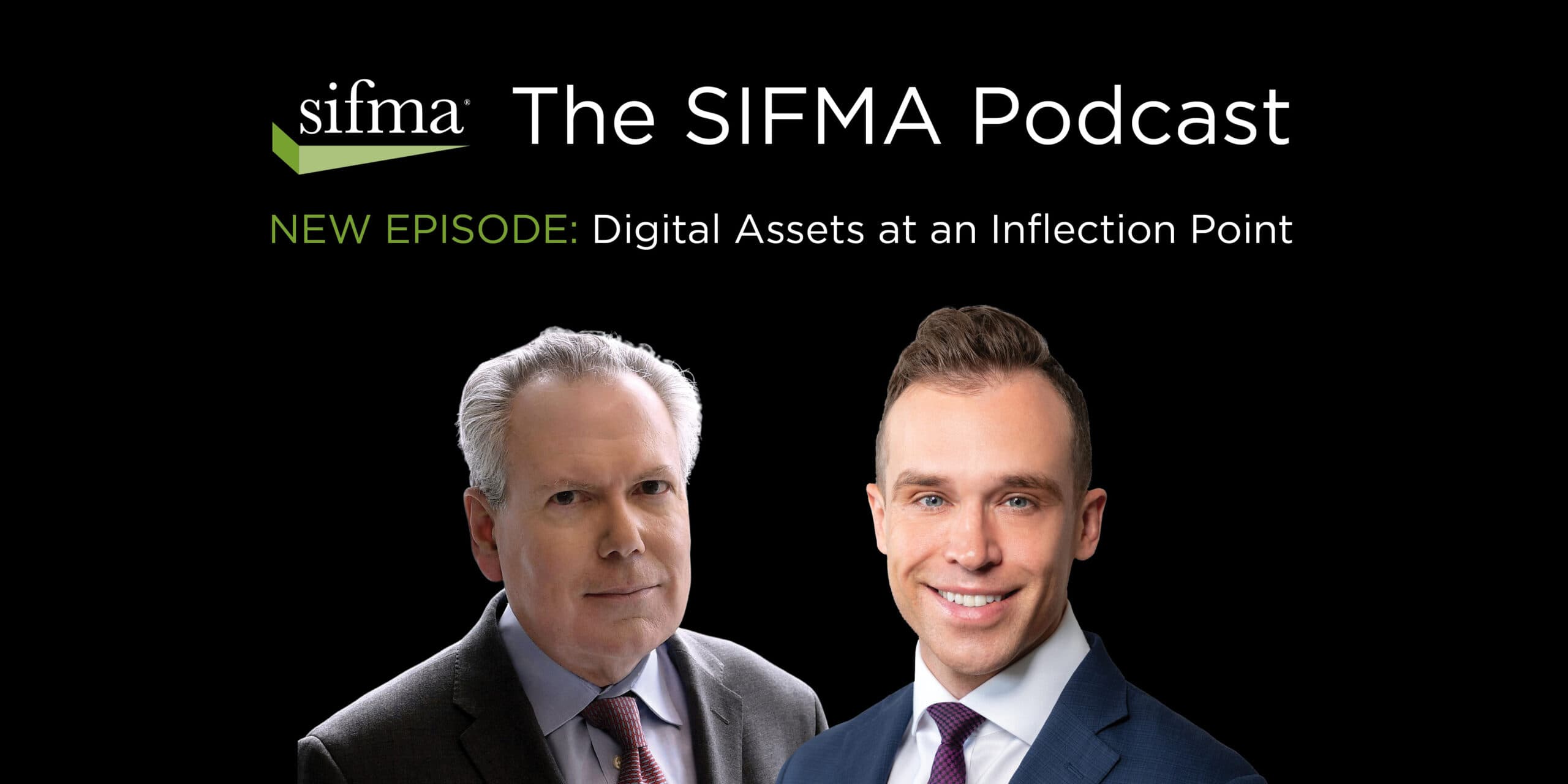
In this episode of the SIFMA Podcast, Kenneth E. Bentsen Jr. speaks with SIFMA’s Peter Ryan about the rapid evolution of digital assets, tokenized markets, and stablecoins. They discuss how regulatory clarity, institutional adoption, and emerging market infrastructure are accelerating the integration of tokenization across the capital markets ecosystem.
You can listen to this conversation by following “The SIFMA Podcast” on Apple, Spotify, YouTube, or wherever you get your podcasts. Sign up to receive new episodes, delivered right to your inbox.
In This Episode
- Why digital assets and tokenization are reaching an industry inflection point
- The growing role of tokenized securities, repo, money market funds, and equities
- How regulatory developments, including the SEC’s crypto initiatives and the GENIUS Act, are shaping the market
- SIFMA’s principles for digital asset regulation, including investor protection and market integrity
- The rise of payment stablecoins, tokenized deposits, and digital cash solutions
- Key operational and market structure challenges facing tokenized markets
- Why traditional financial institutions are accelerating their digital asset strategies
- What to expect from tokenized markets over the next 12–18 months
Featured Guest
Peter Ryan
Managing Director, Head of Digital Assets and International Prudential Policy at SIFMA.
Dr. Ryan leads SIFMA’s digital assets team and serves as staff advisor to SIFMA’s Digital Assets Committee, coordinating the organization’s digital assets initiatives across policy, regulatory, and operational priorities.
Transcript
(Edited for Clarity)
Kenneth E. Bentsen Jr.: Hello, and thank you for joining us for this episode of the SIFMA podcast. I’m Ken Bentsen, SIFMA president and CEO. And I’m pleased to be joined today by my SIFMA colleague Peter Ryan, Managing Director, Head of Digital Assets and International Prudential Policy for a discussion of digital assets. As always, we welcome your comments and questions. Listeners can reach us at digital at sifma.org. And with that, let’s dive into the discussion. Peter, thanks for being here today. So, Peter, you’ve been deep in the whole digital assets work that we’re doing at SIFMA and what’s going on across across the ecosystem. For listeners who may not be tracking this as closely as you or or myself, what’s changed in the past year and and what do you think makes this different from where we were 12 to 18 months ago?
Peter Ryan: Well, thanks again. I think the conversation has really evolved in the last 12 to 18 months. And I think it would be not too much of a stretch to say that we’re really in an inflection point in the development of digital asset markets and tokenized markets more generally. You see lots of tokenized securities projects going live currently in tokenized repo, tokenized money market funds. You see tokenized equities coming live now. We see the development of digital cash markets with payment stablecoins and tokenized deposits acting as a settlement like for securities transactions. And you’re seeing the application of digital ledger technology or DLT across the securities lifecycle. And all of this has been happening in the context of a changed political and regulatory climate. We have a much more permissive regulatory climate that’s really encouraging regulatory clarity around digital asset activities. And that’s been incredibly important. The SEC has prioritized this through the Project Crypto Initiative, through the establishment of the SEC Crypto Task Force, through other actions that they’ve taken, and which we’ve been very engaged with. As you noted in comments with Commissioner Peirce this morning, 12 submissions that we’ve sent to the SEC, and we remain very engaged with them with the staff and in discussions with them. There’s been the passage of the Genius Act, which established a comprehensive regulatory framework for the regulation payment stable coins. That’s still in the process of being implemented, but as that comes live, that’s providing greater regulatory certainty to those markets. The prudential regulators have also provided more certainty about when banks can and cannot engage with crypto asset activities, and also begun to provide some more certainty around the capital rules for those activities. And beyond the regulatory climate, there has been additional change in the market. We now have infrastructure grade, custody solutions, live tokenization projects that are out there. Participants in the market are really seeing benefits in terms of collateral efficiency, fund tokenization, for example. So they’re really seeing those benefits, and the demand is starting to rise too. And surveys show that financial institutions are going to prioritize tokenization initiatives and building those out over the next two years. So again, you have this change in the regulatory climate, the political climate, combined with the availability now of institutional grade solutions and real client demand.
Bentsen: You know, it’s interesting. As you mentioned, we’re at SIFMAS Operations Conference, and we’ve had Commissioner Peirce, as you mentioned. I just heard a panel which had a number of what we call both TradFi as well as digital or new fi, if that’s a term, on there, talking about it. Certainly walking around the halls, around the exhibit hall. Um, you know, there are a lot of buzz and talk about it, frankly, as much as you’re hearing about AI. And and what’s interesting, though, at the same time, I I was talking with one of the big consulting firms. You know, we’ve been talking about blockchain distributed electrotechnology for more than a decade at SIFMA, across the industry, um, and even on the this panel today, the the uptake has been slow and coming. And even if you think about it in traditional securities, the tokenization has is not as large as one might think. But sort of as you just laid out, do you think we may be on the cusp of with the regulatory clarity, with the continued engagement, particularly of not just the new entrants, but traditional market participants of a of a boom in this market of greater tokenization?
Ryan: Well, you’re right. This is this is a the market as it currently exists is still relatively small. I think $26 billion in tokenized assets globally. That, however, represents a 280% growth rate from the year on year. Um, so the trajectory is very clear. This market is expanding, it’s growing rapidly. There are lots of capital markets use cases that are being explored. I mentioned collateral efficiency, which is incredibly important. Um, and that’s an issue that our one of our reports, Briar, our global affiliate, the GFMA, highlighted. Um, and that can really deploy capital much more efficiently across the markets. We’ve talked about intraday repo, and we’re seeing live intraday repo projects that are being that are launched and are active in the market today. Um, and fixed in fixed income, you’re also seeing this fastest settlement that’s offered by digital budget technology, whether it be treasuries, corporate debt repo again. So, again, you’re seeing all of these live use cases coming online. So definitely the expectation, I think, is that they’re gonna continue to expand as we get greater regulatory certainty. And also that we deal with the cash flag and have viable cash like alternatives such as tokenized deposits and payment stable coins. Our expectation is that these markets are gonna continue growing, but most likely existing in a hybrid format alongside conventional markets.
Bentsen: Yeah, the cash lag is interesting in the sense I was talking with one of our member firms, one of our directors recently, and the idea where you would have tokenized equities you know trading on various blockchains, so not a central, not a central repository or and almost like European model where you have 26, 27 clearinghouses, where here we have one. And so how do you deal, I mean, how do you avoid the friction of going from one to the other? And how do you and also the friction is as one of our recent panelists commented, in the traditional securities markets, pre-funding is usually something people don’t want to do. And so that cash flow is going to be uber important. It’s gonna be incredibly important indeed. So let’s you know, go back to SIFMA’s work um in this. What are what are the core principles that we’re talking about at SIFMA as the regulators, policymakers, the industry talks about setting the rules for this marketplace?
Ryan: So we’ve had a few core principles that really have animated all of our work, all of our submissions to the SEC, the work that we’ve done in the payment staple coin space and other areas as well. I think the lodestar of that is investor protection and market integrity. We believe that the success of the U.S. securities markets, the reason they’re the deepest, most liquid, most efficient in the world, is because of those investor protections and market integrity measures. And if tokenized securities markets are going to succeed in the long term, it’s important that we maintain those and preserve those rather than weakening them for those markets. That’s been really important throughout all our work. We’ve also really emphasized the importance of technology neutrality and the same risk, same activity, same regulatory outcome principle. So that means that if regardless of the technology you’re using or the network you’re employing, you should be treated the same for regulatory purposes. And the regulatory analysis should really be based on the activities and risks, the functions that you’re performing, not on the form or label. So for example, people often talk about decentralized finance or DeFi. you know, our view is if you are performing functions that are akin to acting as a broker dealer or another regulated intermediary, if, for example, you are engaged in venue creation or order routing, or if, and particularly if you’re earning compensation based on those activities, you should be required to register as a regulated intermediary as a regulated broker dealer. If you are purely providing a disinterested technology solution, on the other hand, and the customer controls their own assets and directs all the trading of themselves, then you would be exempt from that, from those requirements. So again, it’s really in the importance of emphasizing this functional-based approach and technology neutral approach. And finally, we’ve also really emphasized the importance of using existing regulatory frameworks where possible. Our view is that tokenized securities are securities. That’s a view, by the way, that the SEC, Commissioner Burse has said on many occasions. So we believe that existing regulatory frameworks have fit for purpose, with the exception of very small subset of cases where you have these genuine square back round hall situations.
Bentsen: So in our discussion today with Commissioner Peirce, you know she made a lot of interesting comments. She and you know, one thing she mentioned was the you know the commentary she’s getting from stakeholders, including, SIFMA and the importance of that. And that, you know, as you mentioned, I think we submitted maybe a dozen letters now at this point to the crypto task force that she leads. And I mentioned to her that, you know, we thought that was a great process. And every time we submitted a letter, she came back with more questions and we had to submit another letter. But that’s the way it should go, and having that discussion. She also said that in the review of what she’s hearing from stakeholders, that’s causing the commission to sort of think about more broadly beyond just crypto or digital assets, are there definitions, are there definitions for things like broker, dealer, market maker, ATS, are they fit for purpose? My words, not hers. But how do you see, because you’ve been intimately involved in what SIFMA’s been doing and engaging with the task force, you know, what are the points we’ve been getting across? How have you seen the dialogue? What are we learning from that process?
Ryan: Well, I think it’s been a very productive dialogue. And I know that the SEC really appreciates the points that we’ve raised. I think we’ve raised a lot of thoughtful questions on a number of different areas. One of those, for example, is in the area of taxonomies and making sure that we are have clear, consistent taxonomies of regulatory vocabulary that’s precise. So while securities and tokenized securities should be treated the same, you have different classes of tokenized securities, natively issued tokens, for example, securities entitlement tokens, which is the DTCC model. You also have tokenized, wrapped securities. And all of those things bring with them different legal and operational considerations. And that’s why it’s very important to be precise there. And the SEC has done a lot in that area. We’ve made a lot of recommendations. You know, we’ve made a lot of recommendations too around trading and market structure. Again, the importance of continuing to have investor protection market integrity measures in those in those markets. And really, there we’ve focused on some of the alternative trading models, such as the non-custodial wallet providers, DeFi, user interfaces, and automated market makers, and said that those entities, if they are performing intermediary-style functions, should be regulated as such. And if you are going to make changes to intermediary-based regulation, which is really where all the investor protection market integrity measures really are sourced from, you need to go through a proper process that’s broadly consultative, not through an ad hoc, no action or exemptive relief process. And also made very clear to the SEC, s you heard Commissioner Purse talk about the innovation exemption. I know it’s a major priority for the chairman, that that should be a narrowly defined, time-bound framework that really has some guardrails around the customers that can access it, at least in the initial phases, and transaction volume to avoid price and liquidity fragmentation around the markets. So we’ve been very clear around that, but we’ve also been very clear on a number of other issues, particularly custody. And we think custody is a very foundational issue and something that we’ve talked about in many of our submissions going back several years to the SEC. The SEC’s made progress in clarifying rules for digital asset custody, the repeal of SAP 121, some clarifications around the application of the special purpose broker dealer framework, the control and possession guidelines for digital private keys. So a lot of progress, but more to be done there. But I think engagement on those issues and other issues has been very positive with the SEC. So we’re looking forward to more of it.
Bentsen: How would you respond? You know, there are some, you know, particularly when you get into discussions around regulation legislation that have suggested that, you know, again, TradFi, which is a term I don’t personally like, but a term that’s used quite a bit, um, you know, is is really, you know, is is not in favor of innovation. And yet you walk around this conference we’re at this week, and everybody’s talking about it, as I said, in the same at the same volume they’re talking about AI. Um I was reading about the recent, there’s a big crypto conference that happens every year down here in Florida. There was the other week, according to the media, it was dominated by TradFi firms. From your vantage point, working with our members, it do you, I mean, is your perception as mine that our member firms are absolutely looking at this technology and how they can adopt it?
Ryan: Absolutely. Our member firms are very engaged in looking at the benefits of tokenization, digital ledger technology more generally, across the securities lifecycle, across issuance trading, custody settlements, post-trade processing, and see many advantages. I think, again, the efficiencies that it brings to the process, the fastest settlement potential that it offers, all present many benefits. And so you our our members are really involved in a number of different use cases across the market. Again, as I talked about, some of those are collateral efficiency and collateral management, the intra-day repo example, fund tokenization, you see that happening has happening across our membership.
Bentsen: You know, you talked about the you know the the cash leg of the transaction and and issues around that as you know, maybe one of the larger hurdles that industry is having to deal with. You have been been very driving our efforts around the implementation of the Genius Act as it relates to the markets business. Maybe talk to us a little bit about where you think things stand on stable coins. The U.S. now has a regime under the Genius Act, and it’s not fully implemented yet, but you know, the regulators are working on that. Where does that all stand?
Ryan: So as I mentioned earlier, the Genius Act established a comprehensive regulatory framework for payment stable coins. And payment stable coins are assets, barra assets that are pegged one-to-one to the U.S. dollar. They’re backed by high-quality reserves of cash and other highly liquid assets such as U.S. Treasuries and U.S. Treasury backed products. And what is really happening right now is that we’re seeing the rollout of rulemaking. The OCC issued a major proposal that we just commented on earlier this month. Um, and we’re getting other proposals from other regulators right now, establishing the rules around the chartering regime for federally regulated and also state regulated entities that may become payment stable coin issuers, the reserve requirements, which are particularly important from our vantage point, because that will have a big impact on the capital markets, on the short-term funding markets, on the treasury markets. And that’s why we’ve been very focused in terms of our comments on that, on the redemption requirements, where we really want to make sure that you don’t put in place a regime that encourages runs and then transmits risks to the border markets. We want to make sure that you’re putting a framework in that actually prevents that kind of run risk in the system. And then there are other rules that are being put in place around custody, around capital for these issuers. There is an additional framework that’s going to be put in place for foreign issuers that’s very important, the extraterritoriality provisions of the act. And then there are a lot of important questions that still remain to be answered, such as the tax treatment and payment stable coins, which is very important, not part of the Genius Act, but something the regulators really will have to tackle. There’s accounting treatment, the treatment as collateral for margin transactions. All of those are really important questions where not only will the banking regulators, the U.S. Treasury, which are the designated agencies under the Genius Act, have to deal with, but they need to work in conjunction with the SEC, CFTC, and market regulators to really figure out common solutions to those issues.
Bentsen: You mentioned earlier in terms of, you know, again, standing on the cash flag, you know, you know, stable coins and also tokenized deposits. I mean, those are different. So, you know, what are the different forms of digital money as you see it?
Ryan: So our again, our global affiliated GFMA, put out a paper last month on the use of digital cash and cash in the capital markets. Um and payment stable coins are certainly the most discussed currently. But they’re, as you rightly point out, they’re not the only form of digital cash. Tokenized deposits and deposit tokens are two forms of commercial bank money that exist on a digital ledger or a blockchain. And so really just a representation of commercial bank deposits. There is also wholesale CBDCs or central bank digital currencies. Those are being explored in other jurisdictions alongside their cousin retail CBDCs, not being explored here in the US. And tokenized deposits and payment stable coins offer a lot of the same advantages, potentially as much as 24-7 availability, programmability, so the ability to put instructions into the money. Um they offer, again, fastest settlements and lower cross-border payment costs. So a lot of similar advantages. There are some differences between them. Tokenized bank deposits have the advantage of the legal and regulatory certainty that’s associated with commercial bank deposits today, which is why they’re more likely to be used in the near term as a settlement like for securities transactions. Payment stable coins um have some advantages though. They can be traded and used, used across borders and across institutions in a way that currently tokenized deposits cannot, because there aren’t these interbank bridges that which many firms are working on building right now. But payment stable coins have some challenges. For example, the singleness of money. Many argue that they do not have meet that standard. They also have interoperability challenges between payment stable coins that may be issued here, and let’s say e-money tokens are issued under the EU’s MECA regime, and also the regulatory uncertainty given that the Genius Act is just being implemented. So both are being used in capital markets use cases today, but again, you know, I think in the near term, probably tokenized policy will be more used, and as payment stable coin stablecoin regulations become more established, we’ll see payment stable coin, this payment stable coin market expanding.
Bentsen: Yeah, that you make a good point about the cross-border application, because I mean the Europeans went first with Meek. Obviously, there’s some Japan and some other Asian jurisdictions have regimes, but now with the U.S. going, that it presumably that will drive if it will drive a big marketplace. And the UK is probably coming in behind the U.S. now in terms of doing it. They’re still a little bit further behind. but that that’s good, there’s definitely gonna be friction that’s gonna have to be ironed out at some point, you would think on that. Yeah. What so maybe to sort of wrap it up, you know, we as we talked about, you know, um, you know, 12 to 18 months ago, we were talking about a lot less than we are now. Twelve to eighteen months ago, we didn’t even have a digital committee at SIP, but now we do, that you run. Notwithstanding the fact that we’ve been talking about DLT and block DLT and blockchain for a decade. We’ve done papers on the digitization of securities going back many years. But things have been moving really fast recently. We have the, you know, you mentioned the SEC in their proposed innovation exempt or suggested that they will put out an innovation exemption. There’s applications you know from the exchanges on tokenizing securities. DTCC got an exemption on their intraday. We’re seeing the growth of but they the growth of what you would call it, but the increasing introduction of tokenized money market funds and the like. What are we gonna be talking about 12 to 18 months from now?
Ryan: Well, I think a lot of things will have evolved in 12 to 18 months. I I do think that these markets will still be relatively small scale compared to the size of the overall market. But I think you’re gonna see a lot. More projects going live. You mentioned the DTCC project, the establishment of the Securities Entitlement Token Project. NASDAQ has had an approved rule filing to trade tokenized securities. And so we expect that project to go live. There are many other projects that we also expect will be expanding. So we’ll see a lot more in the tokenized repo, tokenized treasuries, and I think increasingly in tokenized equities too. That will be supported by the fact that you’ll have a cash like both tokenized deposits and payment stable coins that are really starting to scale up. Um, you know, the expectation is that those markets could reach anywhere as near $1 trillion by 2028, potentially, by some estimates. The OCC thinks $500 billion. But regardless, that’s a very significant market growth. And I think that growth in both the in both the cash digital cash market will help reinforce and drive growth in tokenized securities and vice versa. So I think all of that is going to happen. And it’s going to be driven, of course, by changes in the regulatory environment. We know that the SEC is planning to introduce an innovation exemption, as Commissioner Burst talked about. There’ll be no action exemption relief related to that. There is a project crypto assets rule that we expect the SEC to issue soon. We know that they are looking at transfer agent modernization again, something the commissioner mentioned. And we know that they’re looking at custody, including investment advisor custody, investment company custody, as well as stands for qualified custodian. And so we know they’re gonna try to bring greater regulatory clarity to those spaces. We know that there’s gonna be more action from prudential regulators. Obviously, there’s gonna be the implementation of the Genius Act, which is gonna help drive those digital cash markets. So 12 to 18 months from now, you know, I think we will see a lot more projects. There will be GoLive, a lot more institutional scale starting to accumulate. But I do predict, as I mentioned earlier, that we’re still going to be in a hybrid world with both conventional markets operating alongside these new tokenized markets. And that really does you know create some operational challenges that that certainly the professions we’ve been talking to at this conference will have to deal with over the coming years. The one thing I can say for certain is that it’s going to be a really dynamic period for us over the next few months.
Bentsen: Well, I’m confident that we’ll be having another discussion about this inside that time band. And Peter, thank you very much for spending time with us today. And for all of our viewers and listeners, thank you for being with us as well. And for more information on SIPMA’s works to promote efficient, resilient markets, please visit us at www.sitma.org. Thank you.


