Key Takeaways for Asset Managers from SIFMA’s Digital Assets Conference 2026
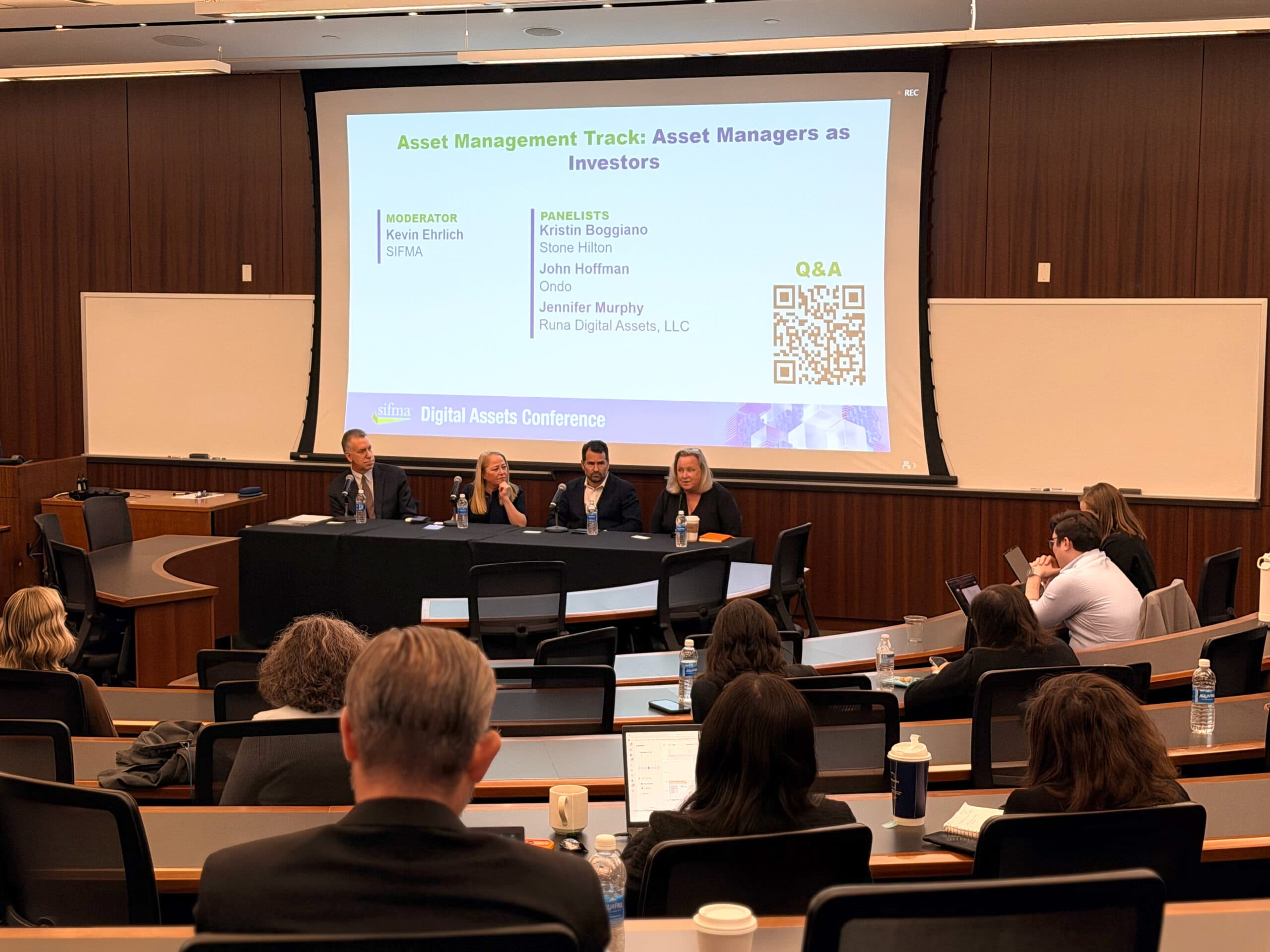
For asset managers, tokenization is no longer a question of whether, but of how fast and under what rules. That was the clear message from panelists at the asset management track at SIFMA’s inaugural Digital Assets Conference, held September 23, 2026, in New York. The sold-out program framed digital assets as entering a new phase, one where the focus shifts from pilots and experimentation to broad adoption across the capital markets.
Setting the Tone: Durable Rules Build Durable Markets
SIFMA supports innovation but believes the best way to foster it is through durable rules that protect investors, preserve market quality, and build confidence in new products and markets.
The anchoring principle, as SIFMA COO Joseph Seidel said to open the event, “same activity, same risk, same regulatory outcome.” Investor assets deserve the same protections – regardless of the ledger they sit on. Seidel also pointed to SIFMA’s concerns with the SEC’s recently released Innovation Exemption, urging a formal notice-and-comment process so tokenized securities markets have the certainty they need to develop responsibly.
For asset managers, that framing matters. It signals that the path to scale runs through the existing regulatory framework, with targeted changes only where new technology creates a genuine square-peg, round-hole problem.
Here is what participants had to say in the two asset management sessions.
Tokenized Products are Moving from Concept to Shelf
Tokenization has moved beyond proof of concept. The more important question now for asset managers, as noted by panelists, is not whether a fund or security can be put on-chain, but where doing so create a better product or more efficient market structure. Early adoption centered on cash, Treasury, and other relatively straightforward exposures, but the conversation is now broadening to credit, alternatives, and other investment products.
The opportunity is operational as much as it is commercial. Tokenization can create new ways to issue, transfer, and service fund interests, potentially improving settlement and collateral mobility, and allow investment products to interact more directly with digital cash and other tokenized assets. Ultimately, the technology is most compelling when it solves an identifiable problem rather than simply recreating an existing product on a new ledger.
The takeaway for managers: the product itself remains a starting point. Moving an asset onto blockchain-based infrastructure does not, by itself, change the underlying economics, liquidity, or investment risk. The potential value lies in using new infrastructure to improve access, efficiency, portfolio functionality, or the investor experience while preserving the protections investors expect from regulated products.
Distribution Is Key
Distribution may be one of the most important drivers, and also constraints, of tokenized products, as speakers noted. Creating the product is only one part of the equation. Managers also need an ecosystem of intermediaries and platforms that can custody, transfer, service, value and report on tokenized securities.
That puts market infrastructure at the center of the conversation. Custody, transfer agency, onboarding and KYC, books and records, valuation, reconciliation, and the ability to move assets between platforms will all affect how quickly tokenized products can reach investors at scale.
Regulatory clarity therefore has a direct commercial effect. SIFMA has pushed for clarity on where existing broker-dealer and custody rules already apply to digital intermediaries, rather than an undefined parallel regime. The more confidently market participants can understand how existing obligations apply in a tokenized environment, the easier it becomes for managers to develop distribution at scale. The objective should be a workable path for innovation within a durable regulatory framework, rather than an uncertain new system.
Institutions Have Led, Retail Following, and Protections Must Travel with the Product
Many of the clearest early use cases are institutional: treasury management, cash and liquidity products, collateral efficiency, and access to investment strategies through digital-asset platforms according to the speakers at the event. These are areas where reducing friction or improving asset mobility can produce a measurable benefit.
Over time, tokenization may also expand how investment products reach wealth and retail channels. But investors expect the same disclosures, suitability standards, and protections they get from any registered fund, and they are not interested in how the ledger works. They are therefore unlikely to adopt a product simply because it is tokenized. The experience needs to be intuitive, the economics need to be compelling, and the applicable disclosures and investor protections must remain.
The common thread is trust. Tokenization can change the infrastructure through which an investment is issued or transferred, but it should not obscure the nature of the investment itself. Investors need to understand what they own, what rights attach to it, where the risks sit and which protections apply.
Scaling Takes Interoperability, Settlement Cash, and Certainty
Individual launches have demonstrated that tokenized products can work. Scaling them across asset management is a different challenge. Several practical considerations discussed last week will determine whether tokenization becomes a meaningful part of the market infrastructure:
- Interoperability. Tokenized products need to connect across blockchains, platforms and legacy systems. Closed ecosystems risk recreating the fragmentation tokenization is supposed to reduce.
- Digital cash. The benefits of near-real-time delivery vs. payment increase significantly when both the investment asset and the cash leg can move efficiently on compatible infrastructure.
- Operations and servicing. Transfer agency, valuation and NAV processes, custody, reconciliation, recordkeeping, cyber resilience, and business continuity all need to work reliably in a tokenized environment.
- Regulatory certainty. Managers need durable and predictable rules before committing capital and operational resources. Guidance and narrowly tailored, time-limited exemptions can help address immediate obstacles, but scalable markets ultimately benefit from clear and durable rules.
For asset managers weighing their next move, the message was pragmatic: start with use cases where tokenization solves a real problem: expanding access, reducing operational friction, improving collateral mobility, automating portfolio activity or connecting previously fragmented markets. The competitive question is increasingly less about who can tokenize an asset and more about who can use that technology to create a better investment and distribution experience.
The Other Side of the Ledger: Asset Managers as Investors
The first session looked at managers as builders and distributors of tokenized products. The second, “Asset Managers as Investors,” flipped the lens to managers as allocators deciding whether, and how, digital assets belong in the portfolios they run.
The Future is a Mix of New and Familiar
Traditional markets becoming tokenized will present new questions and challenges, but lessons can be learned from what has already happened and is happening now, as discussed in the session. Crypto markets have been trading on a 24/7 basis. Intraday repo on distributed ledger platforms is already operating at institutional scale and demonstrates how smart contracts, tokenized collateral, and digital cash can work together in practice.
Risk management disciplines are evolving as the nature of trading and holding instruments changes. Many of the questions are and will be the same but will be asked differently based on the underlying facts of tokenized markets and how they develop. Asset managers are seeking organizational knowledge and expertise through small-scale product and investment avenues but a successful path will solve a commercial need rather than operate as an abstract experiment.
Digital Markets Are Creating New Tools for Investment Professionals
Digital markets are not only repackaging existing assets. They are also enabling more targeted avenues for investment, arbitrage opportunities, and price discovery around the clock.
Digital markets will also lead to markets that are no longer purely local. When exposure to an underlying asset can be traded anywhere around the globe and price discovery events can happen at any time, asset managers will adjust and adapt depending on the needs of their strategies and clients.
Digital and Traditional Assets will Coexist
The future portfolio is not digital or traditional. It is both. Tokenized versions of familiar assets will sit alongside native digital assets and conventional securities, and portfolio construction will need to account for how they interact panelists noted. Portfolios will likely have a mix depending on which instruments most effectively and efficiently provide exposure. At some point, the discussion will shift away from whether an asset is tokenized or not and re-focus on its investment characteristics.
Familiar investment skills and disciplines will remain valid and useful but expand to address correlation, rebalancing across markets that trade on different schedules, and consistent risk reporting across ledgers. It also reinforces SIFMA’s technology-neutral view: an asset should be evaluated, and protected, based on what it is, not the ledger it sits on.
What Comes Next
The asset management conversation at SIFMA’s first Digital Assets Conference made one thing clear: the industry is ready to build, and it wants to build on solid ground. Whether managers are launching tokenized funds or evolving their investment capabilities, the promise is real, but it will be realized through familiar protections, clear custody and intermediary rules, and a technology-neutral approach that regulates the activity, not the label.
The future is now. There are lessons to be learned building from existing markets. As widely discussed at the event, asset managers are not waiting to develop the institutional knowledge necessary to make organizational plans. Digital asset activity is not limited to the United States which implies the need for a global perspective.
SIFMA and SIFMA AMG will continue working with the SEC, the CFTC, and Congress to help shape workable rules for tokenization. To go deeper, explore SIFMA’s Digital Assets Research Brief and our digital assets resources, and follow #SIFMADigitalAssets on LinkedIn and Instagram for conference highlights.