
Getting the Foundation Right
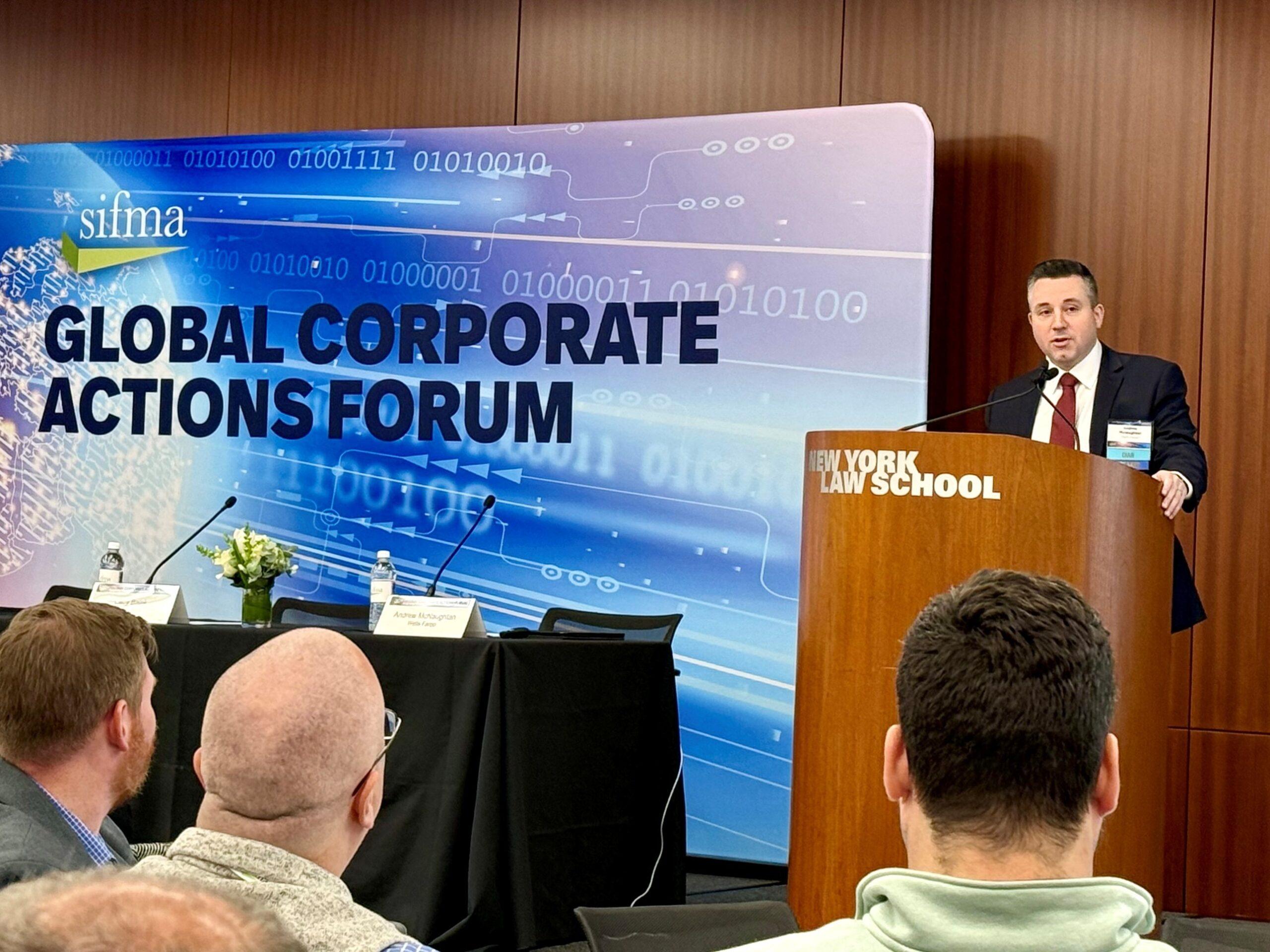
- Attendees ranked data standardization as the industry’s top priority, and speakers stressed that automation and AI deliver value only when the underlying data is sound.
- Extended trading hours and tokenization are moving from concept to operational reality, shrinking the downtime that corporate actions processing has long relied on.
- No single firm can modernize alone; progress depends on coordination across market participants and with regulators.
Corporate actions processing has long been built on fixed market hours, overnight cycles, and a shared understanding of what each event means. At SIFMA’s 23rd Annual Global Corporate Actions Forum, held October 22 in New York City, operations leaders, market infrastructure providers, technology firms, asset managers, and regulators examined what happens as those assumptions change as markets evolve, and what the industry needs to get right first.
Data Standardization Comes First
Across sessions, one prerequisite came up more than any other: standardized data. An audience poll confirmed it, ranking data standardization as the industry’s leading priority.
Speakers traced many of the most persistent operational problems, including reconciliation breaks, exception processing, manual intervention, and inconsistent interpretation of the same event, back to fragmented data. Firms continue to invest heavily in technology, but that investment pays off only when the data feeding it is accurate, consistent, and standardized.
AI Supports Expertise; It Doesn’t Replace It
Artificial intelligence was featured throughout the day. Participants described practical uses already within reach: flagging discrepancies, extracting key terms from complex event documents, and giving operations teams better information to act on. The consensus was that AI strengthens human judgment rather than substituting for it.
Speakers also offered a caution: automating a fragmented process doesn’t fix it, it just produces errors faster. For firms planning modernization efforts, they pointed to several priorities:
- Improving data quality and consistency to support straight-through processing.
- Reducing manual exception handling through better validation and standardized workflows.
- Applying AI responsibly to document review, data extraction, and reconciliation.
- Building workflows that can absorb greater speed and volume as market structure evolves.
Extended Trading Hours Leave Less Room for Error
The move toward extended and potentially near-continuous trading challenges processes designed around defined market hours and overnight cycles. Participants discussed implications for entitlement determination, claims processing, timestamp precision, and exception handling. With less downtime between cycles, firms will need more automation and more resilient operating models.
These concerns closely track SIFMA’s work on extended trading hours, which has identified a range of operational and regulatory considerations, including processing, resiliency, supervision, and reporting.
Tokenization Moves From Concept to Implementation
Tokenized securities were another recurring focus, and the conversation has clearly shifted from what tokenization might enable to what it takes to support it. Speakers outlined emerging operating models and their implications for ownership records, dividend processing, proxy voting, and governance obligations.
Two principles framed the discussion: first, investor rights, including proxy voting, shareholder communications, and entitlement processing, must work the same way regardless of how an asset is issued, held, or transferred. Second, tokenized assets should integrate with existing market infrastructure rather than run on fragmented parallel systems that add complexity for issuers, intermediaries, and investors. Both points align with SIFMA’s view that innovation must go hand in hand with operational resiliency and investor safeguards.
Regulatory Coordination Ties It Together
Whether the topic was trading hours, tokenization, transfer agent modernization, or proxy reform, participants returned to the same need: clear, consistent regulatory frameworks that support innovation while preserving investor protection and market integrity. The industry’s operational experience is essential to making those frameworks practical and scalable.
What Comes Next
The Forum’s clearest message was that these priorities are connected and are not separate workstreams. Progress on each depends on the others, and none can be delivered by a single firm.
SIFMA will continue working with regulators and industry stakeholders on these issues, including extended trading hours, transfer agent and proxy modernization, shareholder proposal reform, and investor privacy under the non-objecting beneficial owner/objecting beneficial owner (NOBO/OBO) framework. To learn more, read Extended Trading Hours: A New Frontier for U.S. Equity Markets, Protecting Investor Privacy: Why the NOBO/OBO Framework Matters, and SIFMA’s testimony on tokenization and the future of securities.

Related Resources
Global Corporate Actions Forum
Extended Trading Hours: A New Frontier for US Equity Markets
Protecting Investor Privacy: Why the NOBO/OBO Framework Matters
Testimony on Tokenization and the Future of Securities: Modernizing Our Capital Markets
Details
More Content
- The SIFMA PodcastNov 06, 2026
Market Snapshot: What’s Ahead for the Economy and Markets? Featuring Steve Liesman, Scott Anderson and Mark Zandi
meta description for this? Hear Steve Liesman, Scott Anderson and Mark Zandi discuss the 2027 economic outlook, GDP growth forecasts, Fed policy and key market risks on SIFMA's Market Snapshot. - The SIFMA PodcastNov 03, 2026
Resilient Markets: Strengthening Market-Wide Resilience Featuring Debbie Guild, PNC, and Brian Peretti, Everstream Advisors
Episode 1 of SIFMA's Resilient Markets Series examines operational resilience, industry testing, reconnection frameworks and market-wide collaboration.