
General Marks and Peter Tchir on Geopolitics, Markets, & Leadership
- SIFMA Editors
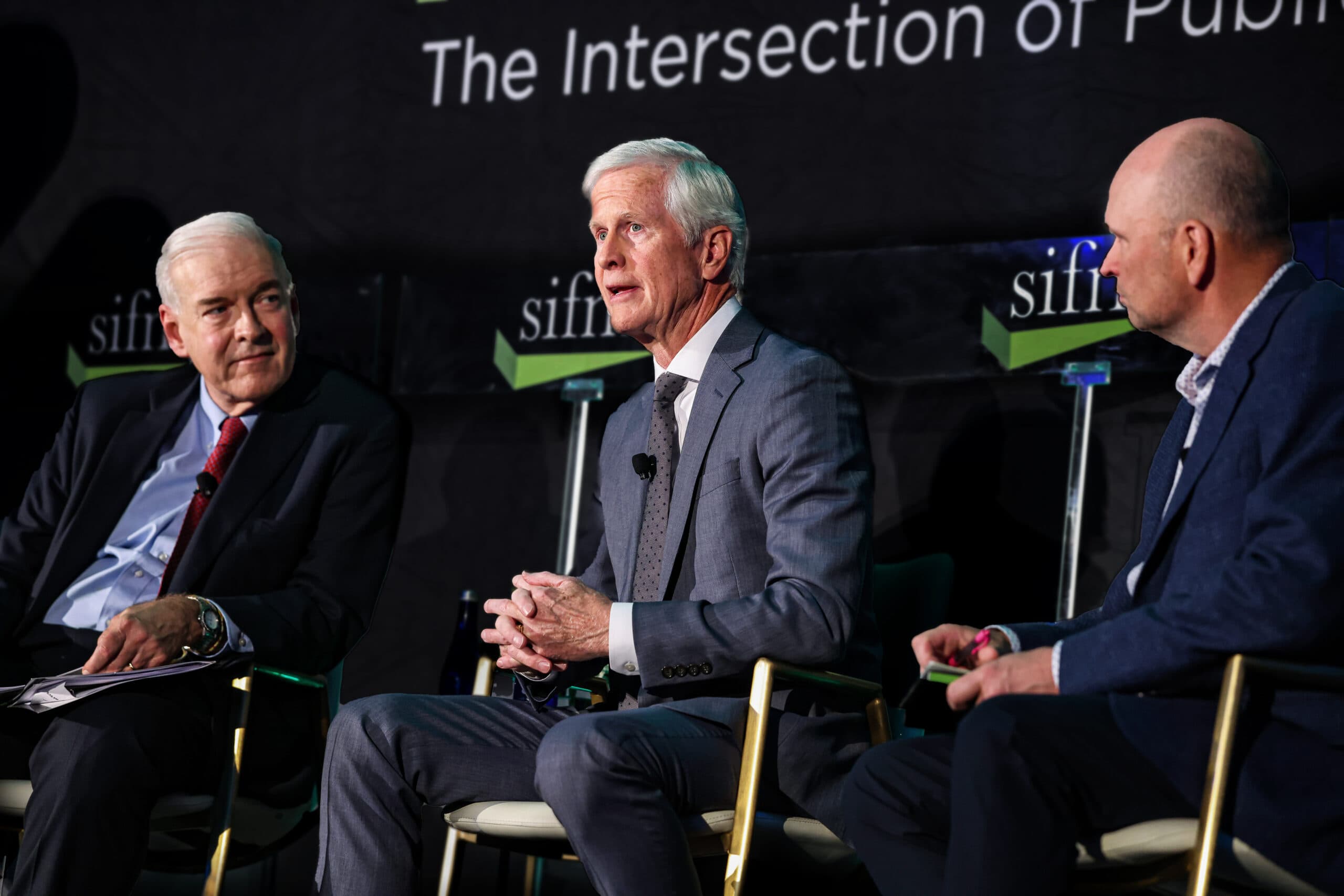
A Conversation at SIFMA’s 2025 Annual Meeting
At the 2025 SIFMA Annual Meeting, Major General (Ret.) James A. “Spider” Marks, Head of Geopolitical Strategy for Academy Securities, and Peter Tchir, Head of Macro Strategy for Academy Securities, explored how today’s geopolitical fault lines are reshaping risk, supply chains, and investment strategy.
From a “pre-war” mindset and deterrence to “production for security” and the future of energy, chips, and critical minerals, the discussion connected global flashpoints to practical leadership and implications for investment portfolios.
Key Takeaways
- From post-war to pre-war: General Marks contends we’ve shifted into a pre-war era—one that demands deterrence beyond the military alone (diplomacy, information, economics) and daily decisions that reduce escalation risk.
- ProSec will rival ESG: Tchir framed production for security (ProSec)—re-onshoring or allied-shoring of essentials like chips, power, pharma, and critical minerals—as a durable investment theme that will drive corporate strategy, regulation, and capital flows.
- Supply chains, energy, and minerals are the new chokepoints: Expect policy and investment to prioritize electricity generation (for AI/data centers), semiconductor capacity, and processing of rare earths/critical minerals—alongside shipping-route resilience.
- Hot spots & scenarios:
- Middle East: Ceasefire dynamics remain fragile; peacekeeping ≠ peacemaking; long horizon and high complexity.
- Ukraine: A negotiated outcome (with land concessions) is possible as winter reduces fighting, but funding mechanics (e.g., frozen reserves) and European coordination will shape timing and markets.
- China: Risk of a sharper trade confrontation is underappreciated; firms should diversify shipping lanes and reduce single-route dependencies.
- Policy tools to watch: Expanded use of industrial policy (targeted investments, deregulation), portfolio margining across markets, and—on rates—greater willingness to anchor yields if volatility rises.
- Leadership lessons from the field: The “contrarian intel” role—stress-testing plans, naming vulnerabilities early, and staying mission-focused—translates directly to boardrooms and investment committees.
Speakers
- Major General (Ret.) James A. “Spider” Marks, Head of Geopolitical Strategy, Academy Securities
- Peter Tchir, Head of Macro Strategy, Academy Securities
- Joseph Seidel, Chief Operating Officer, SIFMA
Transcript
Joseph Seidel: Thanks for joining us and it’s great to see you again. So, the introduction we just did, barely touched the surface of your various experiences in your-
General Marks: And I apologize for the lengthy introduction.
Joseph Seidel: Oh no, I’ve seen you’re full thing. We could add another couple pages there, I think in terms of some of the exploits and all over your time as a service, but you’ve been in combat intelligence and various other things. You’re now in financial services in the advisory world. Can you walk us through the pivotal moments or decisions that took you on that path from…
General Marks: Oh sure.
Joseph Seidel: … intelligence officer, platoon leader to Academy Securities?
General Marks: Yeah, I’ll give you the executive summary version of that if you don’t mind. But after 30 plus years in uniform, as an intel guy, your obligation is to tell your bosses and your colleagues how screwed up they are. That was my job. Everybody in those various organizations, we all had a mission and we all knew what it was, purpose and task, and we were focused in that direction.
My job was to poke holes in all of those plans and to put a red hat on and say, “Look, our opponent is going to do this to this rather brilliant plan, put together all you incredibly talented people,” and to provide that contrarian view, which is difficult place to be.
I was the guy who routinely had some bad news for the crew, but as a result of that, what you realized is you acknowledge, you have to acknowledge every organization, every person has got some immense vulnerabilities and let’s point them out before it becomes incredibly costly, and without being too personal. I’ve put too many incredibly talented young men and women in the ground. So, it is very personal.
After that, clearly, I wanted to continue. After a service donation, I wanted to continue. The rear-view mirror is much smaller than the mirror in front of you as you’re driving your car. And I knew that there was a lot of opportunity and there was good that I can continue, I would hope that I would be able to provide.
And I was very fortunate to literally bump into the founders of Academy Securities and they were looking for a contrarian voice who would give them some ideas on geopolitical strategies and challenges and it was wonderful. The only hard swallow in all of that, it was two Naval Academy guys invited me to join the team. So that took some very long conversations.
Seriously, I was absolutely enamored by the opportunity and then having a chance to work with my colleague, Peter, who is, as a macro strategist, is frankly a savant and has lived in this world forever and he brings incredible insights and is routinely not shy about telling me how to get back into a particular box or on a certain azimuth. That’s an executive summary of all of that.
Joseph Seidel: Well, it sounds like you’ve had a very lengthy and interesting path. So, Peter, tell us a little bit about yourself and how you’ve worked at the academy, [inaudible 00:03:16] with the general.
Peter Tchir: So, I think the running joke is I must be our token pacifist because I’m only Canadian, but I started with a much more traditional background, computer science, the MBA, started on Wall Street in the credit derivative business, did a lot of structured products.
General Marks: Vandy, MBA, top 10.
Peter Tchir: There we go.
General Marks: Football right here.
Peter Tchir: It’s a good sports weekend lately. And from there…
Peter Tchir: … I actually got very involved in the CDX indices, so helped to actually create the CDS suite of indices. I was a board member of CDS and [inaudible 00:03:44] traded about a trillion dollars of credit throughout the financial crisis. Wound up at a small hedge fund. We stayed small too long and started then advising large asset managers, built up that business, grew that, sold it to a company, continued there and joined Academy about eight years ago now because I thought one of the neat things is not just talking to asset managers, but also getting to talk to corporations and now a lot of municipalities and states.
So, get this interesting background and I try and bring my experience from the credit and finance side of things to do what I do and then, we can pair it off and really with what’s going on, on the geopolitical front, and I think we’ve become better and better at identifying things that are tactical. So, what do you have to be watching out for the next weeks or months on geopolitical front, that’s likely, but also more importantly probably what do you need to be thinking about five years down the road, whether it’s shipping, our relationship with China.
We are talking about rarest and critical minerals five years ago. Now, finally, everyone’s talking about that. So, I think it’s been this neat when we can really combine those two issues.
Joseph Seidel: Well, and then as the head of geopolitical strategy at Academy, General Marks, you have a platform to combine your security, strategy and markets experience or the two of you combined in terms of the market building, and your decades of experience around the globe. From that vantage point, how do you currently access the current geopolitical risks facing the nation and the world today?
General Marks: Really?
Joseph Seidel:
You’re not…
General Marks: I think there are plenty of opinions in the room here. Yeah, this is going to be incredibly understated, right? It’s not unprecedented, but the level of chaos is, I think, we’ve seen this before, but the volume of information and velocity of information has never, this is unprecedented. So, we deal with these minor changes as a matter of routine and we have to absorb those and then make some decisions as a result of those.
What we see as fundamentally, I think, is several things that we’re seeing right now. Number one is a shift in the spheres of influence over the course. World War II just ended 80 years ago, which is a blink of the eye when you think about it. And Pax Americana, United Nations, Bretton Woods, what we know and what we have assumed and embraced over the course of those 80 years, which developed you, developed the systems that you participate in and work with as a matter of routine, are now being challenged in a way that we’ve not seen before.
Which really leads me to the second point, in that 80 years, we were very much a part of a post-war world and we’ve now progressed into, what I would inarguably describe as a pre-war world. But the good news in that is that if you acknowledge, if you agree with the fact that we’re in a pre-war period, then what are you doing about it to prevent war?
Because over the past century plus, we were in pre-war circumstances, but we didn’t realize it until that inflection point hit and suddenly, we’re in the midst of legitimately described as an out of control, what are we going to do next, kind of an environment. Excuse me. But we’re now in a pre-war situation. What you do on a daily basis, impacts in terms of whether we’re going to progress to a war or not.
And in fact, Peter has really designed this notion of production for security. And I will demur to Peter to describe, that allows us to be in a position if we consider ourselves vulnerable and we should, what can we do to prevent that? And it’s not inevitable.
The next inflection point, which is now we’re in a war, we’re in the midst of incredible challenges right now. And the next war is going to look very much like we’re seeing now, just a greater number of those engagements, and it will be conflict that is continuous and it’ll be economic, and we have to redefine what those challenges and what those enemies look like.
And I think of all the lawyers in my past, they would give you very, very, very definite definitions in terms of what an enemy combatant looks like. That’s all changed now. And enemy combatants can be financial guys, they can be terrorists in a whole bunch of different manners, and we need to be able to embrace that and understand what we do today matters. Deterrence matters, not just kinetic deterrence, but deterrence in a whole of government manifestation, diplomacy, information, military, as well as economic and how we apply that.
I think that’s the big, big muscle movement that I see right now that needs to be embraced. We have an obligation to stay attuned to that and to make daily engagements that are going to prevent what could be the next, what I would call major conflict. But we may slip into it, like we have in the past, we may slip into it and realize going back or at least the opportunity to prevent it was lost.
Peter Tchir: And if I can pile onto that, I think how we phrase this and what we’ve been trying to turn this into as advice is we call it ProSec or production for security. And honestly, I think this is going to be as big or the equivalent of ESG. You’re going to see it shape, how corporations think, how investors think. You’re going to see a slew of ETFs created around it. You’re going to see government policies change, and I think it’s starting with the US and abroad.
And I would say, some of this started a little bit with COVID when that was our first shock of how susceptible we were to supply chain issues. That was the first wake-up call. And then, I think in the last year, two things have really happened: We want to be good at data centers and AI. Everyone in the world wants to be good at data centers and AI. Well, you need a lot of electrons to make AI or data centers run. And I think it became pretty apparent we’re woefully inadequate right now at producing the electricity we need or are we going to need. So, that I think, is driving part of this.
And then, I think through the trade negotiations with China, it became again, very apparent that we really lack the processed and refined versions of the rare earths and critical minerals. We lack the rare earths and critical minerals themselves, but there are places that can be produced and we can buy it from them, we can develop our own, but it’s the processing and refining.
And so, when I look at production for security, it’s going to include chips, it’s going to include pharma, it’s going to include rare earths and critical minerals. It’s going to include basically anything that we need at some level to be sustainable. I think when we look at ESG sustainable, I think we took a very cavalier view of it. Oh, we’re sustainable so long as we can buy all this from China. Well, that’s not really sustainable. How do we make our country? How do you make your own supply chains? How do you invest in this?
So, I think we’re going to see a different shape in terms of how we think about governance, how we think about this. And I’m just going to throw this out there and I think there’s probably a lot to debate and we can probably do it over a drink, but if you look at the CHIPS Act and how that was trying to help the chips industry versus a direct investment intel, two very different approaches, two different sets of strings attached, both moving things along. And so far, it seems arguably that the direct investment’s moving more.
I think you’re going to see a lot more of this. We all forget that Trump was mentioning a sovereign wealth fund when he started. That is dissipated. I expect we see more of this and we are going to see a lot of direct investment to jumpstart these industries, and I think you’re going to see corporations think about this much more. They’re not going to close their eyes and say, “Oh, we can outsource that to China because it might be dirty, but at least it’s not dirty on our soil.” I think we’re going to see this change and I think Europe and the rest of the world is going to catch on fairly quickly.
And one thing that I think has been very positive in the past few days, Trump is now talking to Australia about some of this. It seems he’s maybe talking to Alcoa. So, I think some of the tensions that have existed between the allies will disappear as each country goes along doing this and figuring out how to do what they can independently and with other allies. And that’s going to be, I think, the big growth story of the coming years, and it is going to change, I think, how people invest and manage their companies.
General Marks: You know what? And I would say, if you look at the map, if you look at the global intersection of where we have been concentrating for years, I would say to this crowd, you understand it absolutely implicitly, which has always been where can you get LNG? Where can you get oil? Those are the hotspots. Let’s make sure we can protect those distribution lines. What do the global commons look like? Where that competition exists?
And that’s completely migrated now to rare earths. And the only thing that’s, rare earths are not rare. They’re just rare to us. We don’t have a bureau of mines. We can’t get after a lot of that stuff. And so, when you look at the critical metals that are out there, I mean, just go online and look at Google NATO’s top 10 or 12 critical metals and you can see where the intersections are and then go to a map and find out where they are. That’s where we need to stay engaged.
And in my mind, not political at all, but Make America Great Again, which has some really significant negative undertones to it, I never knew we weren’t great, frankly. But when you look at it, you realize what that means is exactly what Peter’s talking about, are we great in terms of our ability to ensure that our national security imperatives list them can remain imperatives and become non-negotiables? There’s a lot of work that we need to do, and there’s a lot of work we can do at home to ensure that.
I mean, just think about it, the shift in spheres of influence. Marco Rubio, when he became Secretary of State, he went to Panama. He didn’t get on the phone and call Great Britain. He did not say, “Thank you very much for burning our White House.” We are still very much in love with Great Britain-ish, I think, they would say that, but he ended up going to Panama primarily because of the Chinese. And I think and what we’re seeing in South America today with Venezuela and Colombia, a love affair that’s going on with Argentina and Malay, I think it’s important to realize that that has long been overlooked.
So, we can wrap ourselves and I guarantee you, what’s taking place? You can’t speak for the administration, but what’s taking place in terms of those military operations. Right now, there is a legal finding that says that’s okay, but you line up 10 lawyers, you’re going to get 10 different answers. So, let’s have at it. So, let’s not discuss that right now, but the point is, is that there has to be an effort.
This is what I see is America’s latest version of containment, which worked very, very well up until December. We completed it essentially in December ’91, with the collapse of the Soviet Union. We are seeing intrusions and challenges of America in multiple avenues in what we call those gray zones. And so, we need to act accordingly.
Peter Tchir: And I would just pile on to Spiders, I think the concept of pre-war versus post-war, Spiders was talking about it a couple of weeks ago, it’s been resonating with me, and one of my things has been not in my backyard or NIMBY, and let’s be honest, it’s my town has awful cell phone service, but every time they would go to put up a cell phone tower, everyone says, “Whoa, whoa, whoa, you can’t put it there.”
And I look at the country and to some degree, we built up a set of regulations. I know obviously, both on the financial and security side, which I won’t get into, but when you look at our production side, we built up all these regulations over a course of decades and part of that was done when we were the sole superpower.
We were basking the glow of the peace evident of the Soviet Union collapsing. We really didn’t have an economic or military threat to think about. And I think if we really start to have this pre-war mentality, I think pre-war means we have to start doing things to make sure that we are capable and we scare our enemies so that they don’t actually want it to escalate this to war. So, pre-war is not a bad thing if it ultimately leads to war.
General Marks: If you can’t do pre-war, you better do war.
Peter Tchir: Yeah. So hopefully we can do pre-war, but I think you’re going to see a lot of regulations that were put in place revisited. Does this still make sense now that we have real economic competition? And I think that’s something that the Trump administration should be good at. It’s Howard Lutnick, I think, has fought regulation all his life. Trump, himself, has fought regulation all his life.
So, I think that will be an interesting growth area we want to see, and I think that’s more domestic. You can do that without annoying the rest of the world and we can get things done. But I think that’s all going to be part of if we develop this pre-war mentality.
Joseph Seidel: So, would you all sort of advocate or suggest we should be looking at some type of enhancements to things like the Defense Production Act to appropriations to things like that, to build it through governmental processes or more of an industrial policy in terms of the tax code? How do you sort of get there in terms of-
General Marks:
My short answer is, yes, we should and we need to have some very-
Joseph Seidel: All of the above?
General Marks: Yeah, and we need to have some very focused efforts. Now, government should not be directing what those are, but I would say it’s pretty obvious that if you’re looking at the defense industrial base right now, autonomous platforms, we have to make sure we’re good there; electronic warfare, maritime access, area denial, missile defense, et cetera.
There are some very clear insights that we’re getting from these two very significant wars that are ongoing right now, and don’t think for a second that we’re not extracting a bunch of lessons learned. Not only at the application of that one element of power called military, but across the board in terms of how we do that and what does that look like.
Peter Tchir: Yeah. And I think when I look at the chips, the pharma, biotech, rare earths and critical minerals, I think that a lot can be done just through deregulation. I think when the government does invest in another company, it sends a bunch of signals, right? Okay, the government’s there, now all of a sudden, it’s easier to get lending. I think when the government invested in MPs, the magnet company, it also came around with $1.2 billion of additional financing. So, it lowers the cost of capital. I think it incentivizes them to use it.
It gives people comfort that, “Hey, this company might be around or this industry’s got something to go for. So, I think that will work.” I think the military is going to be a bit trickier because it’s a behemoth. One of our generals tells the story, he was in procurement under Trump 1.0 and he said, “This was the first time it ever happened,” but the person came in. “So, what are you spending a billion dollars on this? Why?” “Well, that’s in the budget.” “What are you spending a billion dollars on next year?” Same thing. “Why?” “Well, it’s in the budget.” “Do you need this?” “If you were starting tomorrow, what would you spend a billion dollars on?”
So, I think this is something where maybe the administration looks at these things a little bit different and shakes it up and moves us maybe, not necessarily, I’m going to let Spider talk to this, I think we’ve had these big, beautiful platforms, aircraft carriers, Patriot missiles. The problem is we’re spending a million dollars to shoot down something that costs $10,000. China can turn basically every factory into a drone factory because it’s not that difficult to make a drone factory. It is incredibly difficult to make a Patriot missile, so you’re not going to turn a new Patriot missile.
So, I think as we look at what this military, it’s going to have to shake things up. I think that’s going to be harder because I think it’s going to have to change a little bit of how about politics works in DC, but I think there’s that momentum. And again, if we have this pre-war mentality, we’ve put people on the moon, we’ve built the nuclear bomb for better for, that’s the sort of mentality I think we need to address this to catch up or get ahead of where we are with China.
Joseph Seidel: So then, looking at some of the hot spots around the world, I guess, just sort of taking a tour of the globe, how do you rate, what are you most concerned about pre-war turning into something more than pre-war in terms of the various regional things: Gaza, Ukraine, China, LatAm?
General Marks: Yeah Joe, I would say my thought of this truly has evolved over the course of what we’ve seen since the invasion of Ukraine almost four years ago, and then, Hamas’s activities against Israel, two-plus years ago. I thought what happened in Israel would be Andy Warhol 15 seconds of fame. Got that wrong.
Israel essentially said never again, and they’re in the midst right now, and oh, by the way, let me not bury the lead, the ceasefire is a ceasefire. It’s going to remain in place. I haven’t been involved in ceasefires before. Shit happens all the time at the 18-year-old level, and you just have to have good leadership that says, “Cut that out.”
Sadly, Israel lost two soldiers yesterday, murdered by Hamas fighters that popped up from underground, fact of life. That doesn’t mean, and then they leveled a couple of those buildings and that will continue to happen, but the ceasefire will continue. I’m optimistic and thank goodness our vice president is there. Hopefully, that’ll give everybody, will assuage some of the concerns, but I thought that would be over with pretty quickly. I’m less optimistic.
I mean, the fact that there’s a ceasefire, there’s a lot of green on that pool table between where we are now and operational success and the ISF, the International Security Force that’s being brought together with a bunch of Muslim nations to include Indonesia, which is wonderful, their mission is peacekeeping, not peacemaking.
And now, there’s discussion about bringing that force and injecting them in a contested way to make peace. That’s not their mission. There’s little appetite for them to have that mission internally in their own capitals. They don’t want that. They want the money, they want the ability to go in there, keep people apart, maybe having been in new informations, those suck. So, you have some real challenges. Even if peace has been made, then you have to have a peacekeeping force and it has to be monitored over the course of time and it has to be sustained. I think that’s got a really long horizon.
I’m more optimistic that what’s going to happen in Ukraine might have a positive outcome in that, the killing I hope will stop. There will be a trade-off of land, will in fact, go to Russia, now as a discussion point, whether it’s the entirety of the Donbas and the landmass from the Donbas to Crimea, I’m of little faith that that’s ultimately going to go back to Ukraine, and Zelenskyy, I think, has embraced that as well. But this is not, we’re migrating into the non-fighting season.
So, what’s the incentive for Putin to not continue what he’s doing? I don’t know if there’s going to be some magical promise in Hungary in a couple weeks. I’m not optimistic that’s going to happen, but I do think there’s a possibility there primarily because Putin is now sitting on, he loves where he is. He’s an aggrieved president of a nation that’s at war. That’s exactly where he wants to be, but he’s got a wartime economy, no goods and services going to the population.
He will understand that at some point and be dependent upon that axis of upheaval that I call it, China, Russia, North Korea and Iran. They’re going to continue to support them in some way, but that will be unsustainable. And I think, if there can be an agreement that you get to keep what you have and maybe a little more, I’ll demur to Peter again in terms of what happens to the frozen reserves. Maybe those go back to Russia. How does that work? But I think, I’m more optimistic that we can probably reach something there than we will in the Mid-East in the near term.
Peter Tchir: And I think, from our standpoint, the frozen currency reserves are an interesting one. I’m pretty sure from our insights that Trump won’t touch the US holdings of that and it’s fairly small. It’s only about 10 billion, but I do think he’s putting pressure on Europe to do something about it. There’s about 300 billion in the system, and that would then do a couple things: One, it would allow the system where we sell weapons to Europe, Europe can then, in turn, give it to Ukraine and Europe can now pay through them through the frozen Russian reserves that they keep.
So, I think that would change the dynamics of the bond market. You’d actually have global yields, I think, come down a little bit because part of what’s been pressuring global bond yields has been this fear of how Europe’s going to subsidize or come up with all the money to do this. So, I think that’s interesting.
The two things I think that concern me most of the geopolitical falling into something, one is more near term and is that I think we underestimate China’s relationships with the autocratic resource rich nations. China has really developed trade with a lot of autocratic resource-rich nations. Autocratic because that’s where I think we were weak. We would go into these autocratic nations, tell them, “Well, you need to do this, this, this and that.” And China would just say, “Here’s a bunch of money, give us your stuff.”
But since then, China’s been selling more and more their goods, right? China, I believe, the top three selling cell phone brands in India are all Chinese. And not that India’s necessarily an autocratic resource of nature, but that’s an example of how China has these. We’re down to only 15%. Chips are not, we’re still dependent on chips coming out of Taiwan. Do they do something to slow that down? Do they decide, “Hey, the US is finally making progress on rare earths and critical minerals. They finally realize this is real. Do we try and do something with that now?”
So, I’m a little bit worried that near term, we’re going to get a bigger trade dispute than I think we’re currently prepared for. I think everyone keeps talking about TACO or Trump always chickens out, I think this time China’s been driving it, China’s been pushing it. I think China might be more prepared than we are to fight for either getting the chips that they want or something. So, I think there’s a real risk that this breaks down.
And longer term, I think the one thing most of us all do, when we look at the companies we invest in or talk about, I think people still take shipping for granted. And I think shipping’s already been proven through these various choke points that it can be susceptible, but China is involved in almost every port in the globe. They own, not just parts of a lot of these, it’s their equipment in these. They have not yet used this to their advantage to say, “Hey, we’re going to prioritize Chinese ships over ours.”
But when we’re advising corporations, we basically tell them, “When you look at your supply chains, Thailand and Vietnam does not mean you are really geographically diversified. They are going through the same shipping routes.” So, trying to work with companies and say, “Let’s just be cautious that shipping may not be a given.” And it’s not just a matter of whether it costs 10 or 20% more, it takes 10 or 20% longer, what if there’s severe disruption? So, I think you want to know A, change your shipping lanes a little bit, make sure you diversify shipping lanes and also producing some at home so you don’t have that risk.
General Marks: Peter, if I may…
Joseph Seidel: Sure.
General Marks: … do you think there’s a possibility based on everything you just said because of a couple of things, that there might be a Putin-Trump grand bargain, primarily because in my mind, and China’s got some significant heavy lifting over the course of many, many years. Really, clearly, they’ve got a huge debt problem from the BRI.
They’ve got a deflation, real significant deflation risk and demographics are terrible for them. So those are all long. These are longitudinal issues. So, do you think that there could be some type of a grand bargain with Russia where that vassal State of China, Russia and the United States now come together to try to wedge?
Peter Tchir: I think it would be very risky for Putin to risk pissing off China. China supported them, and I suspect that nothing comes from China without strings attached. So, that would strike me as a very dangerous thing. And it would also strike me as something that he would have a lot of difficulty believing Europe can get behind or that the US might stay behind if there is a change in administration. It’d be interesting if it happened, but it’s hard to believe.
General Marks: We’ve been fooled. I mean, when Trump 2.0 came in, I thought for sure he’d get on the phone and call Xi and say, “Hey, let’s get together and let’s throw a blanket-
General Marks: Yeah, let’s throw a blanket over Putin. Clearly, that didn’t happen, so.
Joseph Seidel: So, in dealing with the geopolitical situation, then you would suggest that from the US point of view, they would enhance the defense production or the supply chain productions? Is it done by diplomacy? What should be the US role in this?
General Marks: Clearly, look, the way I always viewed the relationship between the Department of Defense, Department of War and the State Department, was that if you didn’t invest in the State Department, you better invest in the defense department. Because in my mind, every time I showed up at someplace, it was because the economic systems and the diplomatic systems failed. And then, they throw a bunch of young men and women out of an airplane and say, “Go, unscrew this thing.” Not a good solution.
So, we have to be able to have that connective tissue. I mean, the challenge across the board is within all those elements of power is always economics, and that’s going to drive how we view our relationships and where those real tensions are. We have to be able to have a clear-eyed view of how we need to stay engaged. Otherwise, we end up with very little insight in terms of where that next challenge is coming from until it’s way too late, and that’s done through what you guys do for a living.
Peter Tchir: And I would say, from my perspective, I think a lot of what I’ve said today seems fairly positive. I like the direction. I think Liberation Day was a disaster. I mean, I’ll highlight one thing, for example, like the tariffs on potash where the US gets 90-some-odd percent of its potash from Canada, we tariffed it. Two weeks later, we had to give 40 billion of emergency money to the farmers because their expenses gone up.
And a lot of these things were very transactional, and what I can’t figure out, and I don’t think we’ll know the answer for the next year or two years is has the American brand, the image of who America is changed? What are countries thinking about as they deal with America? And I think it’s one thing to be very transactional in business because if you think about, there’s always someone who’ll sell you another golf course. If you run out of golf courses in Ireland, you can go to Scotland, and if you off every real estate person in New York or Chicago, there’s something else you can do.
There’s only 20 countries that are truly important, and they do have a muscle memory. And I’m not sure how easy it is to go back what the business as usual will be, and no one’s going to say a lot out loud in front of the president because no one wants to attract his attention. But I assume behind the scenes, there’s a lot going on where people are rethinking how do we do this? How do we care about this? Do we still want to buy American brands the way we once did?
There’s potential shifts. I don’t know which way it’s going to play out, but I think we set a lot of things in motion that we’re going down, in my opinion, a train record. We’ve massaged those back to a place that’s better, but there are leftovers that I think the world doesn’t know how it’s dealing with yet.
Joseph Seidel: So then, oh, go ahead. Yes sir?
General Marks: No, no, no.
Joseph Seidel: So then, how do you integrate your geopolitical views into your capital markets work? Does it change your view of capital allocation, risk management? How do you guys bring that to the day job, if you will?
Peter Tchir: I think it’s been most helpful in some of the commodity space where we can look at that. I think it’s been driving this view of ProSec, and I’ll be honest, I own intel. I still own a bunch of intel. I think the government’s going to do a lot. And this isn’t about whether-
General Marks: Be careful, Peter.
Peter Tchir: This isn’t how I would necessarily do it, and I think it would be better if there was a structure around the government investments rather than it’s fairly ad hoc, but the president likes to win, the president wants to win. The president would view intel stock going up as winning. So, look to that, look to these rare earths and critical minerals. I think you want to be heavily overweight that it’s somewhat dependent on the AI trade, but it’s not as much.
I do think he is going to wind up giving up in solar and going for solar, and solar’s another interesting area. I think he doesn’t like it. I don’t think he likes wind either. I think he’s got some additional reasons not to like wind, partly it kills things and he does not like things being killed. It’s just he doesn’t like that concept. Partly, supposedly it destroyed his view at his…
General Marks: Golf course.
Peter Tchir: … golf course. So solar, I could see, and I think every single advisor is telling him solar has to be part of our thing. I think nuclear’s going to be a huge part, so that shapes that. I think it’s affected our view on rates, why we think that, again, with this administration, the geopolitical stuff going on, the potential for the Russian dollar reserves, we think yields are going to continue to go lower. We think this administration will take steps that have been used in the past of some sort of reverse operation twist.
They might go towards something as terms of yield curve control. It feels like every time we get through a crisis, we get closer and closer to yield curve control. We’re not there yet, but I think you will see efforts to keep this yields anchored. So, it’s driving where we’re recommending investment. We’re very comfortable with credit, we’re very comfortable with that. I think the economy’s slightly worse.
And I think the one thing we probably all have to realize is every report that you probably read is probably slightly better than maybe it would otherwise be, because no one wants to attract the attention in this administration a negative way because that is not a good thing, and Trump does watch TV nonstop. He reads nonstop. So, I think we’re all trying to figure out how do you live in this world where you don’t want to annoy thing and try and figure out exactly how to play this.
But I do think there’s this huge opportunity, and I do think this concept of ProSec, it’s going to start here. It’s going to last years and years and it’s going to go global where Europe and every other country is going to have to go back and say, “We need to do this.” And that’s probably the biggest thing that if I had to say, what shapes our geopolitical view overall and how I’m turning into strategy, that’s it right now.
General Marks: Well, and they signed up Europe, they signed up for the 5% GDP contribution. That will be fungible, what that really looks like, but they’ll march in that direction of 5%. I think it’s long overdue, needs to have been done years ago.
Peter Tchir: And a lot of that will probably be done in infrastructure spending as well.
General Marks: For sure.
Peter Tchir: So, they will use, “Oh, we can fix our port because we put Navy ships in the port,” but they really wanted to fix their port, and they’ll get to the 5%. As long as no one checks too closely, that’ll be fine. Sorry, Spider, I didn’t mean to interrupt.
General Marks: You’re good.
Joseph Seidel: Yeah. So, you all are at a veteran-owned, service disabled-owned veteran firm. What is it like, what advantages are to that? What competitive advantages do you bring that way? What’s your edge and what’s it like in a firm like that compared to you’ve been in other Wall Street experiences, Peter?
General Marks: I won’t answer the Wall Street piece.
Joseph Seidel: Yes.
General Marks: When you hire a veteran, I mean, it’s absolutely magical. These young men and women, we have about 180 folks in the firm, 50% are veterans. Veterans of these wars over the course of the last 20 years. Your kids coming from your neighborhoods, they’re absolutely wonderful. They’re gifted. So, they’ve got a sense of discipline. They’ve got a sense of purpose. They’re incredibly creative. They’re thoughtful. They’re selfless. Who doesn’t want that when you’re making a hire?
Look, I would tell you, I’m not in your world intimately, but I can train financial shit. What you can’t train is values and discipline and a sense of being a part of something that’s much larger than yourself, and that’s the challenge with most veterans. I mean, they spend any amount of time in uniform. There is no doubt why you’re showing up every day, zero. It’s all about those guys and gals that you’re left and right.
In our firm, we achieve that and then we get them spun up so incredibly quickly, but you link them up with a savant like this and then in no time, we’re putting these young men and women in front of clients and it’s marvelous.
Peter Tchir: And I’ll give you three quick personal stories, I think, really highlight it to me is, I’m in our Del Mar office and get in the office, they’re like, “Who’s orange Corvette’s there?” And it’s like, “It’s the interns.” That seems weird. And then, you meet the intern, he’s 30 years old. He’s single. He’s been living on military bases for all that. So, it’s not so unusual. And then, we meet the Chicago intern who’s become phenomenally successful, and you meet, again, the intern.
So, these were SkillBridge interns. So, the military allows for the last three to six months of service for them to work for a corporation. They get paid by the military. They get to experience with us what’s going on. And you meet him early 30s, he was a marine helicopter pilot, transferred out of marine helicopter pilot to become a Marines Corps Special Forces.
They changed the rules, no longer allowing anyone who’d been trained as a helicopter pilot to transfer because of the cost of training the helicopter, but he has three girls under the age of five, so this isn’t your typical intern, and they’ve done very well. They’ve grown with the firm. You see it.
And the opposite side of it was a good friend of ours, her husband worked at a larger bank and was put in their MBA program because they didn’t quite know what to do with them, and it was a struggle because he was 10 years older. He had a kid. So, I think it’s been really nice to, we sit there and we’re able to guide them, help them, train them and watch them expand. And they have an alphabet soup of things on their resume that I don’t understand because the military people understand it, but I wouldn’t understand it, but it’s all incredibly useful.
They’re self-motivated. They’re team players. And I think the coolest thing that, to me, at Academy, and I did not have the military background or training, is you would think it would be very order-oriented. And the neat thing is we have every Tuesday at 11:00 a.m., a firm-wide call because they want leadership wants everything to be informed what’s going on, so, the leader of each group.
So, I think it’s a much more collegial and teamwork and working together to focus on one thing than I would’ve thought necessarily, and that’s been really exciting. It’s really neat to be a part of. And then, you see someone who has these three young girls who’s being successful and jumpstarting, and could not probably have got that start at a firm because he wouldn’t fit in the traditional pecking order or role.
General Marks: We’re the only bank in Midtown that has a chin-up bar too. But if you listen to Hegseth, he said he didn’t want any fat generals. So, I turned to all my admiral buddies, you’re off the hook, man.
Peter Tchir: Fat strategists are allowed, though.
Joseph Seidel: We have some outstanding veterans at SIFMA too, and we can certainly attest to that. So, before we run out of time, or as we run out of time here, looking forward, what do you see as the greatest opportunities, biggest risks over the next 12 months?
General Marks: My view is that we’ve reached a point of what I would describe as digital authoritarianism. The bar is so low. Anybody can engage in the conversation and throw complete pablum and nonsense, and then it gets turned into our generative AI machines, and we have to work our way through those.
And as a result of that, we’ve created a generation, I think, and we have to be very, very mindful of this, of hyper individualism. We are losing this sense of others and being a contributor of being a part of something that’s much larger than yourself, and can you subjugate what you’re interested in to the greater good. How you define that greater good, whether that’s your local basketball team or that’s your firm?
I mean, it’s really, it’s troubling, very, very troubling to me. But we’ll make our way through it and we’ll make our way through it. Great folks like that. I mean, when you look at the notion of generative AI, and we refer to AI as that, we refer to AI as the person sitting next to you like it’s a living, breathing entity. AI is an enabler and you, as an individual, remain either on, in or out of the loop, and we’ve all been in those situations today, I mean, in our lives over the course of the last 30 plus years.
I mean, I’m alive today because I was on the loop, but AI did its thing and kept me and about 60 other great dudes alive. It was wonderful. But we were on the loop. We programmed it, we’d worked it, and everything operated appropriately. So, you have a choice. And so, how deeply you want to engage is based on context and based on the risk of that particular engagement.
If we simply accept and don’t challenge what we are routinely fed, then we’re spiraling. And so, I don’t mean to be the typical Debbie Downer here because there is immense opportunity. I’m eternally optimistic about where we are and where we have been and where we’re going, but we have a vote in all that. So, embrace it.
Peter Tchir: And for me, the biggest opportunity is ProSec, this production for security, and the biggest threat is underestimating China’s resolve and willingness to continue to compete with us and that we tend get sidetracked and they might not get sidetracked.
Joseph Seidel: Very good. Thank you all.
Peter Tchir: Thank you very much.
General Marks: Thank you.
Joseph Seidel: Thank you very much for joining us today.
General Marks: Thanks everybody.
Joseph Seidel: Thank you all for joining us and we’ll turn it over to Ken.
General Marks: Thank you.