
BloombergTV: Ken Bentsen on Tokenization, Market Modernization and What Comes Next
- SIFMA Editors
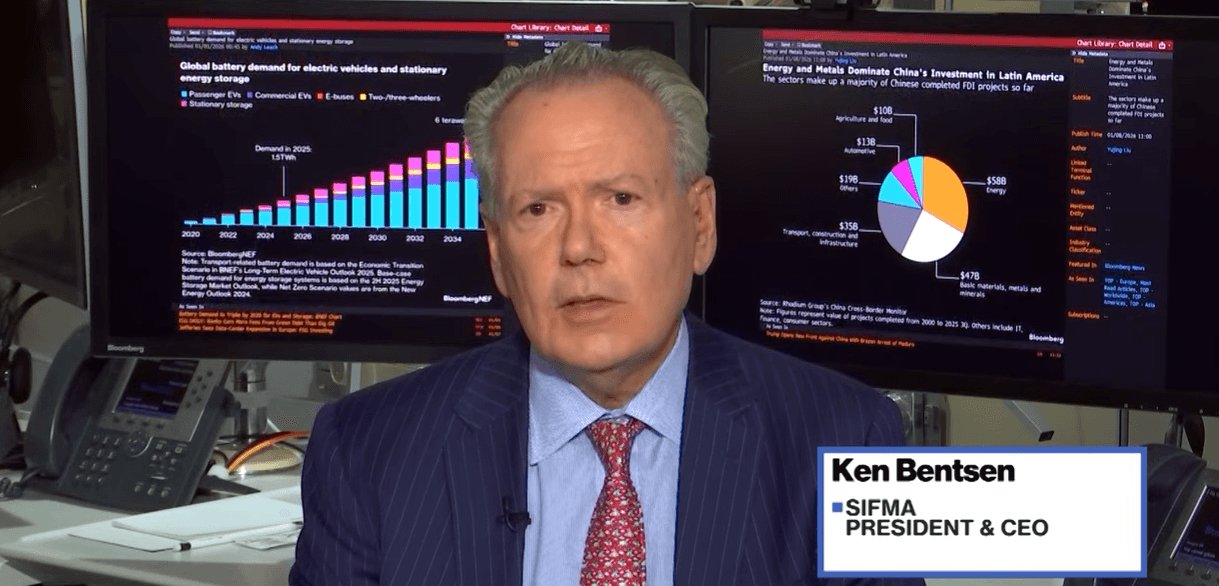
Ahead of SIFMA’s 2026 Annual Meeting in Washington, D.C., SIFMA President and CEO Kenneth E. Bentsen, Jr. joined Romaine Bostick on BloombergTV to discuss several of the forces reshaping U.S. capital markets — from tokenization and extended trading hours to the growing use of artificial intelligence.
Across each topic, the opportunity is significant. So is the importance of getting the underlying market structure, regulatory framework and operational foundations right.
Tokenization Moves Further Into Traditional Markets
The financial services industry has been exploring blockchain and distributed ledger technology for more than a decade. Today, tokenization is increasingly moving from concept toward practical application across traditional financial assets.
Bentsen pointed to activity in areas including Treasury securities and money market funds, while noting that adoption remains less developed in the equities markets.
The potential is straightforward: if tokenization can make market processes more efficient and accurate, it deserves serious consideration. But how tokenized markets operate and how they connect with the existing market ecosystem matters.
That was also the focus of a SIFMA letter to the Securities and Exchange Commission released the same day, which emphasized the importance of establishing strong foundations as tokenized securities markets develop.
For equities in particular, Bentsen highlighted questions that arise when an issuer’s stock may trade across traditional exchanges and new tokenized securities venues. Fragmented trading and pricing, and whether newer venues operate within established market structure protections, are among the issues that market participants and regulators will need to consider carefully.
Innovation can modernize the markets, but the benefits depend on implementation that preserves transparency, efficient price discovery and investor confidence.
The Evolution Toward Extended Trading
The conversation also turned to the continuing expansion of trading hours.
Rather than viewing the near-term direction as fully 24/7 markets, Bentsen described the evolution as closer to 23/5 trading, with major exchanges moving toward significantly longer trading windows.
Extended access may offer investors greater flexibility, but longer trading hours also have implications across the market ecosystem. Trading, clearing, settlement, liquidity and operational support all need to work together.
That makes coordination across firms, exchanges, market utilities and regulators especially important as the traditional trading day continues to evolve.
AI: Opportunity, Risk and a Changing Perimeter
Artificial intelligence presents another significant area of opportunity — and another set of questions for financial institutions.
Bentsen noted that firms have been evaluating for years how AI can complement their businesses and operations. At the same time, the industry is examining the risks that accompany greater adoption, including cybersecurity and operational resilience.
For financial institutions’ own use of AI, he said the rules and obligations are relatively clear.
An emerging area of interest lies outside the traditional perimeter of the industry: how clients and investors are using AI on their own, and where that activity intersects with regulated financial institutions.
As increasingly sophisticated AI tools become part of everyday life, those points of interaction will require continued attention from firms, policymakers and regulators.
Innovation With Strong Foundations
Tokenization, extended trading and AI are different developments, but the conversation highlighted a common theme.
Technology can create meaningful efficiencies, expand capabilities and open new opportunities across the capital markets. Realizing those benefits requires more than adopting the technology itself. It also requires sound market structure, clear regulatory obligations, resilient infrastructure and appropriate investor protections.
Those questions are increasingly central as the industry considers not only what the next generation of markets can do, but how to ensure those markets remain effective, trusted and resilient as they evolve.
Related Resources
SIFMA at 20: Looking Back, Looking Ahead
SIFMA at 20: An Interactive Timeline
2026 SIFMA Annual Meeting
SIFMA’s latest work on Digital Assets and Tokenization
SIFMA’s latest work on Extended Trading Hours
SIFMA’s latest work on Artificial Intelligence
Details
More Content
- The SIFMA PodcastNov 06, 2026
Market Snapshot: What’s Ahead for the Economy and Markets? Featuring Steve Liesman, Scott Anderson and Mark Zandi
meta description for this? Hear Steve Liesman, Scott Anderson and Mark Zandi discuss the 2027 economic outlook, GDP growth forecasts, Fed policy and key market risks on SIFMA's Market Snapshot.