
America at 250: The Enduring Strength of US Capital Markets
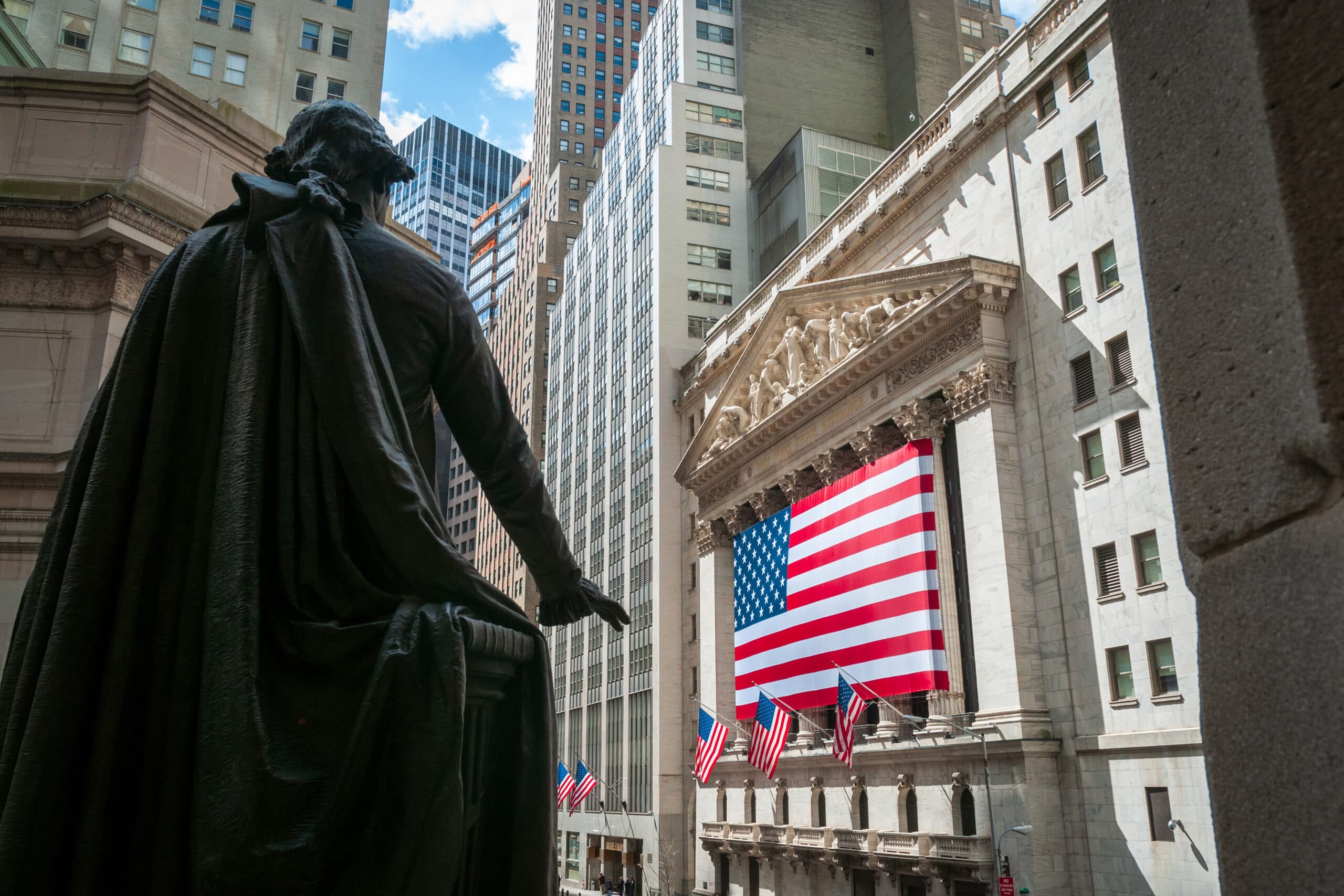
A statue of President George Washington on the steps of Federal Hall in New York City, overlooking the New York Stock Exchange.
When the Declaration of Independence was signed in 1776, there were no U.S. Treasury securities, no stock exchange, no mutual funds, and no public markets as we know them today. The United States itself was still an experiment.
Two hundred and fifty years later, America’s capital markets help millions of individuals save, invest, and build financial security while providing businesses, governments, and communities access to the capital they need to grow and thrive.
Their evolution mirrors America’s own journey, from a fledgling nation to a global economic leader and home of the world’s deepest and most liquid capital markets.
From the Founding of a Nation to the World’s Leading Capital Markets
In the years following independence, the young nation faced a daunting challenge: financing and managing the debts incurred during the Revolutionary War.
Yet the financial condition of the new Republic was precarious. By 1788, public finances were in disarray. The Continental Congress had issued large amounts of paper currency during the war, but without backing in gold or silver, it rapidly lost value. America had no national currency, only a handful of banks and corporations, and no central authority overseeing monetary policy or public finance.
The following year, George Washington took the oath of office as the nation’s first president at Federal Hall in New York City, just steps from where the New York Stock Exchange and SIFMA’s New York office stand today. He appointed Alexander Hamilton as the first Secretary of the Treasury and charged him with building the financial foundation of the new Republic.
Under Hamilton’s leadership, the federal government consolidated and honored debts incurred during the Revolutionary War, establishing the creditworthiness of the United States and creating the foundation for a modern financial system. Hamilton understood that strong public credit would be essential to economic growth, national unity, and the long-term success of the Republic.
A national debt, if it is not excessive, will be to us a national blessing; it will be a powerful cement of our union.
Alexander Hamilton, 1781
In 1790, Hamilton issued approximately $80 million in federal securities to fund and refinance debts incurred during the Revolutionary War. These government bonds became some of the first widely traded securities in the United States, creating a market for investors and helping establish confidence in the nation’s finances.
A few years later, Hamilton championed the creation of the First Bank of the United States in Philadelphia. Not all of the Founding Fathers supported Hamilton’s vision. Thomas Jefferson and James Madison, among others, questioned the constitutionality of a national bank and expressed concerns about concentrating financial power in the federal government. Nevertheless, the Bank was established and became a cornerstone of the young nation’s financial system, helping lay the foundation for the development of American securities markets.

Bank of the United States, in Third Street Philadelphia.
The Miriam and Ira D. Wallach Division of Art, Prints and Photographs: Print Collection, The New York Public Library. (1800). Bank of the United States, in Third Street Philadelphia. Retrieved from https://digitalcollections.nypl.org/items/daf042a0-c5ec-012f-068f-58d385a7bc34
Capitalized at $10 million—an extraordinary sum at the time—the Bank was structured as a public-private partnership, with the federal government owning $2 million and private investors owning the remaining $8 million. Its shares became among the first stocks traded in the country. Shares of state-chartered banks and insurance companies soon joined government securities among the most actively traded investments in the young nation, and trading activity expanded in coffeehouses, auction rooms, and merchant offices from New York to Philadelphia and beyond, laying the groundwork for organized securities markets.
Yet trading remained fragmented and informal. To bring greater order and transparency to the market, twenty-four brokers and merchants gathered under a buttonwood tree on Wall Street on May 17, 1792, signing what became known as the Buttonwood Agreement. By establishing common rules and standards for trading government securities and corporate shares, they laid the groundwork for organized securities markets in the United States and helped shape what would eventually become the New York Stock Exchange.

The original Buttonwood Agreement, signed on May 17, 1792.
NYSE Group
Over the next two centuries, America’s capital markets expanded alongside the nation’s growth—financing canals and railroads, industrial development, infrastructure, housing, education, technological advancement, and financial security.
Today, U.S. capital markets account for nearly half of global equity market capitalization and more than 40 percent of global fixed-income markets. Their scale, depth, and efficiency help businesses access funding, support investors seeking to build long-term financial security, and provide critical resilience during periods of economic stress.

A statue to the first Secretary of the Treasury, Alexander Hamilton, was dedicated on the south plaza of the Treasury building in a public ceremony on May 17, 1923.
U.S. Department of the Treasury
250 Years of Expanding Opportunity
Throughout their history, America’s capital markets have connected capital with purpose, channeling savings and investment toward businesses, governments, communities, and institutions that drive economic growth and improve lives.
The end-users of the capital markets span every corner of our economy:
- Businesses and corporations raise capital to grow, hire, invest, and innovate.
- Governments and municipalities finance infrastructure and public works.
- Individual investors save for retirement, education, homeownership, and other life goals.
- Endowments and foundations invest assets that support hospitals, universities, museums, religious institutions, and charitable organizations.
This broad network of participants is one of the defining strengths of the American financial system. Capital markets help businesses expand, communities develop, and public projects move forward while creating opportunities for investors to participate in the nation’s economic growth.
Over time, participation in the capital markets has become an increasingly important source of financial security and wealth creation for American families. Retirement plans, mutual funds, college savings accounts, and other investment vehicles have broadened access to long-term investing, enabling generations of Americans to share in the growth of the U.S. economy while building their own prosperity and household wealth.
Capital Markets at a Glance
Capital markets help America build wealth.
- Approximately 58% of U.S. households own equities, U.S. households hold $80.4 trillion in liquid assets, and retirement assets total $54.1 trillion, underscoring the critical role capital markets play in long-term financial security.
- U.S. capital markets represent over 40% of global equity markets, representing approximately $67 trillion in market capitalization.
- U.S. fixed income markets comprise over 40% of global fixed-income markets, with approximately $61 trillion in outstanding securities.
- More than 75% of financing for U.S. nonfinancial corporations comes from capital markets rather than bank loans.
- Approximately 77% of corporate debt financing in the United States is provided through capital markets, compared with bank-centered systems in many other regions.
- America’s market-based financing system provides businesses with diverse funding sources that can remain available during periods of economic stress, helping support investment, employment, and economic resilience.
Source: SIFMA
Stewarding a National Asset
America’s capital markets are among our nation’s most important economic institutions. Their scale and success are the result of generations of innovation, resilient institutions, investor confidence, market integrity, and sound regulation.
More than a source of financing, capital markets help businesses grow, communities develop, governments invest in public works, and families build long-term financial security. Their depth and efficiency help explain why the United States remains one of the world’s most productive, innovative, and resilient economies.
The continued success of our markets should never be taken for granted. Maintaining America’s leadership requires policies that support capital formation, encourage investment, promote financial literacy, foster innovation, and sustain the trust and confidence that underpin well-functioning markets.
As we look toward the next 250 years, our responsibility is clear: to steward this enduring national asset so future generations can continue to benefit from the opportunities it creates.
Looking Ahead
The story of U.S. capital markets is inseparable from the story of our nation itself. From helping finance a young republic emerging from the Revolutionary War to supporting the world’s largest economy today, they have helped build businesses and strengthen communities while enabling millions of people to participate in our nation’s economic success.
As we celebrate our nation’s 250th anniversary, we can take pride in a system that has contributed enormously to growth, prosperity, and opportunity while recognizing our responsibility to steward this enduring national asset for generations to come.
Looking ahead, our goal should be clear: to ensure that U.S. capital markets continue to foster innovation, support economic growth, and expand access to opportunity so that future generations can share in the prosperity they help create.
