
Neuberger Berman’s Joe Amato on Opportunity, Market Structure, and the Future of Investing
- SIFMA Editors
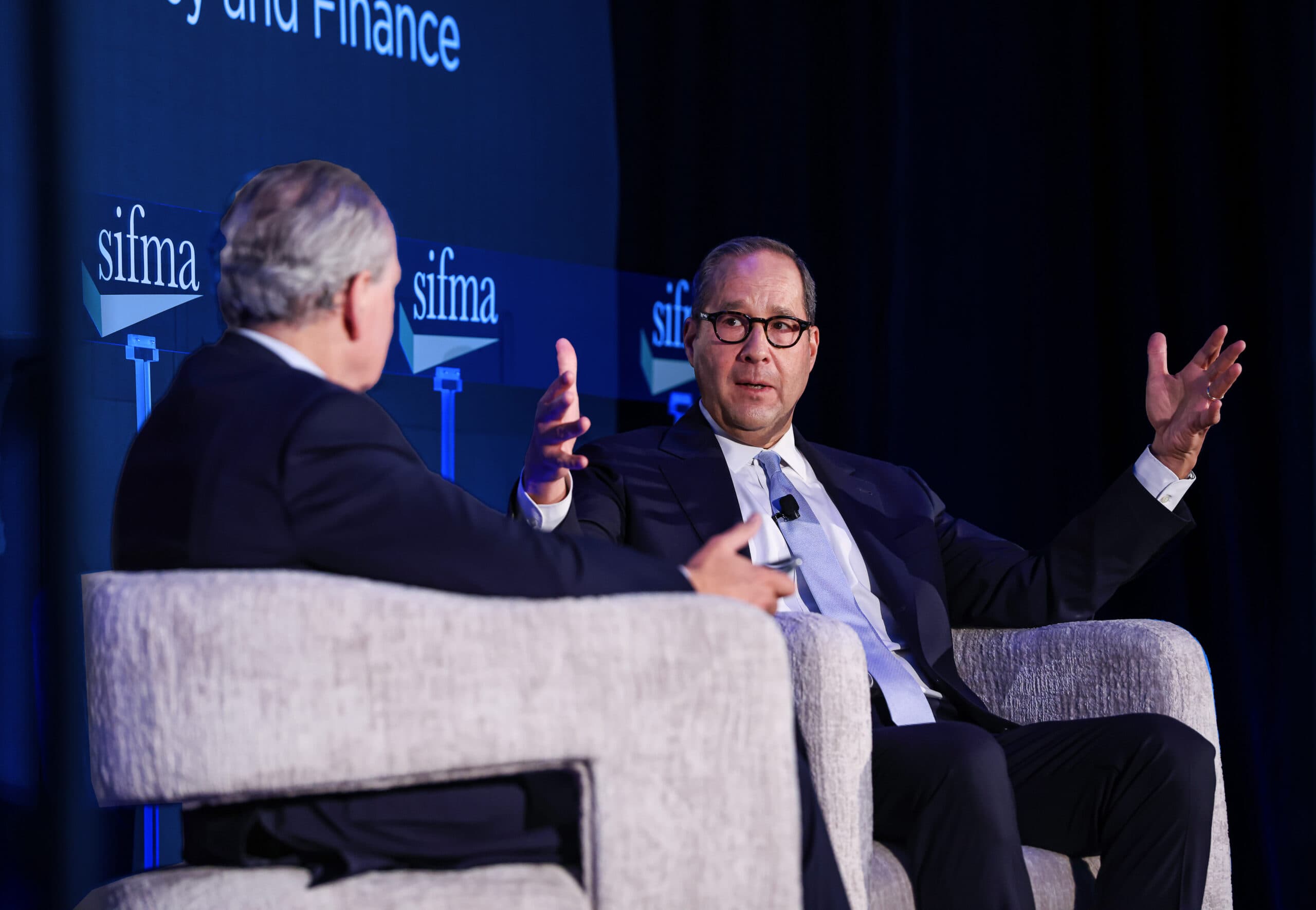
A Conversation at SIFMA’s 2025 Annual Meeting
At the 2025 SIFMA Annual Meeting, Neuberger Berman President and CIO – Equities Joseph V. Amato joined SIFMA President and CEO Kenneth E. Bentsen, Jr. for a wide-ranging conversation on the market outlook, global growth, the dynamics shaping public and private markets, and how AI is transforming investment management.
Amato discussed why he remains constructive on the macro backdrop heading into 2026, how structural pressure points in market structure affect capital formation, and why AI may become the most powerful productivity engine of the modern era.
Key Takeaways
- A rare macro setup for equities: Amato noted that the U.S. economy is accelerating at the same time the Fed is cutting rates—an unusual combination that supports risk assets into 2026. Strong corporate earnings and rising productivity reinforce the outlook.
- Broadening beyond the “big winners”: While U.S. exceptionalism remains intact, Amato expects market leadership to widen. Small- and mid-cap equities, value stocks, and more cyclical international markets—especially Japan and selectively China—should benefit as nominal growth improves.
- Labor market ≠ typical cycle: Evidence suggests a structural shift: softer job creation alongside strong GDP implies meaningful productivity gains, likely tied to AI. This dynamic may keep the Fed more dovish while presenting longer-term policy challenges around labor displacement.
- Market structure pressures capital formation: Two forces are distorting public markets:
- Passive investing’s scale, which weakens long-term shareholder engagement.
- Short-term trading by large hedge fund platforms, which can disconnect prices from fundamentals.
- Both make it harder for companies to navigate quarterly cycles—and may deter IPO candidates.
- Research depth and price discovery matter: Amato stressed the importance of high-quality sell-side research, especially for mid- and small-cap companies where coverage is thin. A healthier research ecosystem improves capital allocation and reduces volatility.
- Private markets: opportunity + responsibility: Retail access to private credit and private equity is expanding—but the liquidity mismatch is the real risk, not the asset class. Frequent valuation, strong infrastructure, and disciplined gatekeeping are essential to avoid a “crack-up” that would damage trust across the ecosystem.
- AI as the biggest change agent: Neuberger Berman sees AI as a massive, economy-wide productivity engine—faster and more transformative than the internet era. Portfolio managers are already using AI to accelerate research, pattern recognition, and decision support. Ironically, operational workflows (compliance, approvals, client communications) are harder to automate at scale.
- Risks on the horizon:
- AI-driven bubbles at the edges of the market as capital floods into early-stage or speculative names.
- Debt sustainability concerns—long-end rates could reprice sharply if markets lose confidence.
- Global divergences, particularly in Europe, where weak growth and political uncertainty weigh on competitiveness.
Speakers
- Joseph V. Amato, President and CIO – Equities, Neuberger Berman
- Kenneth E. Bentsen, Jr., President and CEO, SIFMA
Transcript
Ken Bentsen: Joe, thank you very much for being here today.
Joe Amato: Great to be here. Thank you.
Ken Bentsen: Really appreciate it. And thank you, Neuberger, for your membership in SIFMA. We appreciate that very much.
So let’s start with the big picture.We’ve been living in a period of persistent uncertainty from questions around labor markets, the Fed, to tariffs, geopolitical concerns. When you step back, what’s the through line that gives you a conviction in today’s environment?
Joe Amato: Well, Ken, there’s certainly lots of things that we can all get wrapped up in and there’s lots of issues. There’s no time I think I can ever remember in markets there weren’t complex issues they had to work through. But when we cut through all of that, we look at a US economy that seems to be accelerating off a soft patch in the first half of the year. You have earnings that are in relatively good shape, you had a pretty good first quarter, a much better second quarter and third quarter looks like it’s shaping up okay, and the Fed is cutting rates. So cutting rates and accelerating economy is a rare occurrence when you think about the macro backdrop and I think that’s why risk assets have performed well, and our expectation is that it builds a good foundation into ’26, So when I look at our asset allocation, we’re overweight global equities because of that macro environment.
Ken Bentsen: And when you look globally US, we just talked about you have Europe, Asia, where do you see the best opportunities over the next few years?
Joe Amato: Well, the US is obviously a unique place. I was in China about a month ago, and one of the topics asked me to talk about was American exceptionalism and whether that was going to continue. And I think there is a series of really foundational elements of the US economy that make it very competitive for the long term. And our expectation is that exceptionalism will continue, whether it’s capital markets, whether it’s labor markets, whether it’s good corporate governance, technology and innovation, et cetera.
But as we see a pickup in nominal growth into ’26, we think this broadening out is going to occur in markets. So whether it’s small mid-cap in the US, whether it’s value, some of the areas that have lagged over the course of the last several years as that, again, that nominal growth rate picks up. And you’ll also see outside the US those more cyclical economies. So we upgraded Japan, we’re really bullish on Japan, we upgraded China. So again, broadening out from the narrow set of stocks that have driven the market over the last couple of years.
Ken Bentsen: Japan had a bump this morning, right? With the settled out their political and sort of a high hopes for the new-
Joe Amato: Yeah, I’m excited about that.
Ken Bentsen: … leadership. But Europe? Uncertainty with Europe?
Joe Amato: So Europe, we’re neutral on Europe. I think they’re obviously encountering some political issues of their own. Europe doesn’t have the level of… And I think Chairman Atkins referenced it this morning, I caught some of his comments around the lack of innovation and frankly the dynamism of their capital markets is lacking. So from that sense, you’re still looking at GDP growth that’s less than 1%. We think ECB is going to be forced to cut rates more than the market’s expecting right now. So that may again build a little bit of foundation, but right now we’re cautious on Europe.
Ken Bentsen: And last thing on the US is just, I mean, optimistic, the one area, maybe labor softening, labor market softening, but everything else, all things being equal, you think still optimistic with the direct?
Joe Amato: So we’re doing a lot of work on the labor market because I think there’s more going on there than just we had a soft patch in the first half and labor market’s weakening, which is traditional cycle that you go through. I think you start piecing together things like new graduates struggling to find a job. You look at the economic data on the US economy that was adjusted, right? So the year ending March ’25, the BLS adjusted down the number of job increases by 900,000. Yet over that 12-month period, GDP was reasonably strong, right? So what does that tell you? Productivity is a lot higher. So we think there’s productivity enhancements going on, which again is a good foundation moving into ’26 that does have implications in the labor market and our sense is labor market’s going to continue to grind softer, which probably leads the Fed to be that much more dovish, which again, propels optimism for ’26 in some respects. It may lead to a longer term problem around a labor market that needs to be dealt with from policymaker standpoint, but right now that’s the environment we see.
Ken Bentsen: Okay. So let’s shift gears. We talked about this and you’ve talked about the functionality and efficiency of the US capital markets. And I think I’m getting this correct, well, from your perspective, what are the current dynamics that you think are putting stress on or on the other hand, enhancing market functionality and pricing efficiency? And for instance, we talked, you mentioned issues around growth of passive investing versus active investing, how that may be affecting market efficiency, shorter term investors, hedge funds and others, how that may be affecting market pricing. Are we seeing distortions? How are we seeing the market respond to all this?
Joe Amato: Well, we heard over the course of the morning a number of conferences to capital formation and why the capital markets exist, ultimately to help with an efficient allocation of capital in a market-based economy. So it’s a critical function. In the dynamics of public equity markets, and I’m sure we’ll come back and talk about private markets and at our firm we’re pretty balanced across public and private markets. But on the public market side, the growth and passive has been quite significant, and that does change the dynamic of public markets. So if you just envision with me for a second, a world where passive is a hundred percent of the market, what does that mean for capital allocation? What does that mean for the efficiency of the allocation? Who are making those decisions? Passive is by definition passive.
So we’re not, of course, at a hundred percent, I don’t think we’ll ever get to a hundred percent, but we could be upwards to 50 plus right now. So you have that dynamic that I hear from CEOs and CFOs that struggle with engaging their passive shareholders. So on one hand, in some respects, they’re like, “Great, I love passive investors. They don’t bother me. I don’t have to worry about having a call with them.” But every company stumbles, every company steps in a pothole and I don’t care how good they are. And you want shareholders that understand the nature of your long-term strategy and that engagement process that active managers typically work through is so important to understanding how to price risk. The other end of it is the hedge fund community, particularly the large platforms that put on, as most of you probably know, and they’re amazing organizations, they delivered terrific returns for their underlying investors, so tremendous respect for them.
But they’re putting on four or five, six, seven billion of gross market value in markets. And they’re very focused around short-term returns. We all know how the model works in terms of what they’re focused on, particularly around quarterly earnings. So that just creates a dynamic going back to the feedback we hear from CFOs and CEOs where they’re very frustrated, like, “I can’t engage with a big chunk of my shareholders. Others are super short-term focused. I report a good quarter and the stock trades down.” So it all was about how are the hedge fund’s positioned around the quarter? And it comes back to the core of, look, that’s why folks can be frustrated. So Chairman Atkins touched on I think three different components. I think litigation he said, and a couple others, cleaning up the proxy process, which we would certainly agree with.
But I think one of the pieces he missed is how stocks trade in public markets. As a prospective company who’s going to do an IPO, you’re going to look at that, you’re going to be like, “How am I curating my shareholder list? Who do I want with me over the long term to ultimately drive value for those shareholders?” Versus if I miss one quarter, I lose sponsorship and my stock’s dead for two years. So that dynamic, I’m not sure how you fix it per se, but I’ve certainly encouraged companies to focus on articulating those intermediate to longer term metrics that we as fundamental investors, and in our case primarily focused on that one to three, two to four year time horizon that can monitor the progress of a company knowing that not every quarter may be on that pathway.
Ken Bentsen: An issue that I’ve heard from some of our members, including some of our members who are public, is, I don’t want to say the demise or dearth of research, but research has certainly changed over the last couple of decades and the business model changed dramatically. As an investor, and obviously you all have your own research apparatus, which is quite something, but do you think that’s another part of how it applies to investors? Speaking about the long-termism of public companies?
Joe Amato: I have an interesting history because I ran global equity research at Lehman Brothers, and when I left doing that, I did get through the settlement that I think Ron or you referred to earlier, which had significant fundamental flaws to it. But put that aside, but that did change dramatically the nature and the quality of research that is provided on the sell side. We still think there’s a great amount of research on the sell side. As you work your way down to mid-cap, small-cap less so, which is sort of always been the case. And where my seat is now, we have a big research department. So exploiting those inefficiencies is not necessarily a bad thing for me. But as you think about it from a policymaker’s standpoint, the more quality research you have, the more depth of that quality up and down the cap size, the more efficient capital markets you’re going to have. And that’s a good thing. It may make my job harder, our job harder as an active manager, but it’s a good thing for policy makers to think about. And I don’t know what the current status is on the sell side anymore. I spent 20 years on the sell side now, I’ve obviously switched sides, but that’s probably worth a review and to see how effective that was or wasn’t.
Ken Bentsen: What do you think about the presidents come out and suggested we get away from quarterly TINQs or quarterly earnings reports, some senior corporate executives have come out and said, “Maybe that’s not such a bad idea.” How do you think about that as an investor?
Joe Amato: Yeah, I’m torn a bit. I talked to Chair Atkins when he was leaving about it, and he said he’s… I don’t know if he’s used the term… I probably shouldn’t quote him, but I don’t know if you felt that strongly one way or the other. Right? On one hand you can say more information is good for markets, more transparency, more information. But if you take that to an extreme, then you can argue, “Well, why don’t companies report monthly?” Why don’t companies report daily earnings? That’s more transparency, better for markets. Reality is it’s not decision useful information if you’re reporting daily, obviously, monthly, right? Quarterly, I think it’s valuable. It put a burden on smaller companies for sure. But I think most large companies would probably end up still reporting quarterly. The UK has tried this process, we’ll see how… It’s probably worth a look back to see how effective that is or isn’t.
Even if companies don’t report quarterly, we would strongly encourage them to report supplemental information. It may not be the full quarterly filing with the SEC or even include more frequent information that they would include in the 10K on some semi-annual basis. So I think important information, particularly focused on those intermediate to longer-term metrics that they themselves are focused on. And some of that may require some litigation protection and some safe harbor because you start putting things like that out there and you invite lots of folks to get upset with you if you miss your targets.
Ken Bentsen: Right. Yeah, yeah. I guess I could see where, and even just thinking about the interaction with your investors, interaction with the analysts and you have reg FD issues and things that you might have to take into consideration with that. And I agree. I mean, we’ll see where this goes, but I’ve read that the UK and Europe, I think also have experimented with this, but at least certainly the larger public companies still probably, market kind of demands that they report quarterly.
You talked about private credit and private markets, maybe we’ll turn to that. And you mentioned that Neuberger has been active in private markets for quite some time, GP-led secondaries, direct lending. Where do you see suitable advantages for investors? And particularly a lot of discussion today about, in current times, about expanding access beyond institutional investors, high net worth to retail investors. How are you thinking about all that?
Joe Amato: That’s probably the hottest topic in terms of how individual investors get greater access to these products that for decades institutions have invested in. So there are cynical views on coming to retail, if you will, with these types of products. But our view is why shouldn’t individual investors have the access to these products that have delivered attractive returns? And if you’re an employee of a company that has both the DB plan and a DC plan, you’ve got a much broader selection of capabilities in your DB plan than you have in a DC plan. And that just doesn’t feel like that’s fair and appropriate.
The thing that I’m most concerned about in that is just the mismatch of illiquid assets in liquid vehicles. And I think that requires appropriate care on the part of organizations that help asset managers like us or Blackstone or whoever distribute these products to ensure that there’s not a crack-up, right? A crack-up around liquidity is going to be a black eye for everybody. It’s going to be black eye for distributors, it’s going to be black eye for the asset managers. It’s not a good thing, and the regulators for that matter, so that appropriate care.
But I worry less about the riskiness of the underlying asset strategy. I mean, individual investors, I mean, look at some of the things individual investors trade in every day that have infinite… Wrong term. Significantly higher vol than what they’re going to experience in public equity markets, never mind in private equity markets. So it’s more about the liquidity mismatch than the underlying risk of the strategy.
Ken Bentsen: So we’ve done some work with members looking at practices around valuation, and there is a pretty robust infrastructure that firms, I assume like yours and others who are already in that market, institutional investors utilize to think about valuation. And that would seem logical. You wouldn’t think sophisticated investors would ignore the same principles that retail investors should be paying attention to as well. And so do you think things like the valuation techniques, the transparency, liquidity, obviously you have to match your liquidity needs. You think those are transferable to the retail sector?
Joe Amato: It’s going to demand it because the liquidity and pricing characteristics or structure of those vehicles require more frequent pricing than what you typically have with a big institution. If you’re marking quarterly, you may need to mark monthly or even daily in the case of some private market products. So that creates an interesting dynamic because you might see a higher level of implied volatility or realized volatility in this case versus what institutions have historically experienced with a quarterly marking process. But I think that pricing is going to be important because you have investors coming in and out of that product on a much more frequent basis than in the institutional market.
Ken Bentsen: I mean, is that something that… And you all may be doing this, I don’t know, but we’re certainly seeing traditional asset managers like Neuberger Berman who are looking at developing product. And so I would think that would be something that as an intermediary, if you will, an asset manager could model on behalf of them.
Joe Amato: Yeah, we have an enormous infrastructure that works through the pricing process. Those of you who are part of the broker dealer world that distribute these products, whether it be our products or others do unbelievable due diligence on that as they should, and understanding what that process is because that could be a point of vulnerability. So lots of diligence doesn’t mean there aren’t going to be mistakes made, but there’s certainly a lot of focus on it. Appropriately so
Ken Bentsen: In addition to the work you’ve done as Chief Investment Officer, you’ve been in the industry for many years. You were sell side then buy side, you’re now president of the firm. How do you see running a modern asset management company in today’s world? I mean, Neuberger Berman’s had a tremendous history over the years and spun out from Lehman into what you are today. What is it that makes this firm work in terms of talent, technology in a highly competitive landscape?
Joe Amato: We are a private employee owned firm, so we’re not public. That has been an important, I think, competitive advantage of attracting talent, retaining that talent over the long term. I think stability of senior level professionals is a critical aspect of any successful asset management organization. So I think we’ve developed a model, if you will, that I think has allowed us to track real talent. What has changed certainly over the past 10, 15 years is the development of technology and the technology tools that whether it’s the broker dealer community or the asset management community, all of us have been embracing these tools. In the case of our firm, we’ve invested heavily, we haven’t talked about AI yet. There’s not a conversation that goes on where we shouldn’t talk about AI or that it doesn’t come up. So that’s something that we’ve dove in hard on to give our portfolio managers, in particular the tools to allow them to be that much more efficient in their analytical process.
And I viewed AI as there were sort of three buckets that we were focused on. One is what I call the operating platform, legal, compliance, tech ops, finance, the client organization, efficiently communicating with clients. And then lastly, and if not the holy grail, if you will, the investment world and the insights we can gain. I thought the last part was going to be hardest. In fact, that’s turned out to be the easiest. Not that there’s the answer that you get from using AI, like, “Buy the stock, sell the stock.” It’s not, it’s just the use cases are easily digestible and adopted by portfolio managers that end up saving them lots of time, enhancing pattern and recognition, enhancing their ability to ultimately provide better analysis. The first bucket, operating platform, I thought was going to be the easiest. That’s proven to be the hardest because you’re just changing workflows across multiple segments and you’re changing people’s jobs in a sense.
And that’s more complex. That’ll ultimately come. But it’s interesting what our experience has been.
Ken Bentsen: That’s more of a cultural thing, you think?
Joe Amato: No, I don’t think so. I think just the nature of workflows, right?
Ken Bentsen: Yeah.
Joe Amato: Think about putting in your deck to… You’re going to market to clients through a compliance process. You’re emailing 17 people, it’s coming back and forth. There’s like five different departments involved. And to use AI in that, it’s a more complex thing than telling a PM to say, “Well look, why don’t you use this to, you want to dig into this company, have AI produce you in an afternoon, a detailed 30-page report on XYZ company,” that a mid-level or junior analyst would take two weeks to do. You can do it like that.
Ken Bentsen: Well, two things I would ask about that. So one on the ladder, everything where we’ve engaged with our members and then on our own with outside advisors looking at AI, how do you think about… So you’re right. I mean it can sort, collect, collate that amount of data much faster than the junior analysts. But then how do you think about, “Okay, well, I’m going to go back and check on that data,” and then maybe that brings you back to the governance and the former. How are you thinking about that across the organization?
Joe Amato: Ultimately, our strategies are run by senior portfolio managers, experienced portfolio managers that are not going to take even a junior analyst’s word for it, whether he or she used AI or not in producing that junior level. So there’s iterative process just speeds everything up. And I mean, AI broadly from an economic standpoint is just going to be the most massive creative destruction process I think we’ve ever seen, right? So it’s going to be fascinating. Obviously we’ve seen what it’s done to markets in the first and second derivative companies impacted by AI, but as it gets diffused into other parts of the economy, the financial services world, the industrial manufacturing world, I mean, it’s going to have pretty remarkable impact on, we think on margins even more meaningful than we saw as companies adopted and embraced the internet, even post the bubble bursting in 2000, 2001.
Ken Bentsen: That was going to be my next question. The productivity gain will be greater than it was then and faster.
Joe Amato: Yeah, and faster. I mean, it gives you information. You have big apps like email. This is like, it’s doing stuff for you, right? Email, you’re still engaging in that dialogue or whatever. So it’s a more comprehensive capability that gives us all tremendous leverage.
Ken Bentsen: So maybe to close, you’re sitting down with two groups of people. You’re sitting down with some corporate leaders, and then you’re also sitting down with a group of retirement savers. Thinking about the next year, 2026, what are the two or three risks that you would put at the top of their radar?
Joe Amato: Well, I think we’ve touched on this now a couple of times, and I mean to keep coming back to AI, but there clearly is a huge amount of capital that has flowed into a relatively group of narrow stocks. And I’m not just talking about the largest hyperscaler technology stocks. So it’s both a boom and a bubble. So the Sam Altmans of the world are talking about bubbles. People who are in the middle of it are talking about bubbles. So I’m not overly worried about the kind of dramatic drawdown that we saw back in 2000. I’m around long enough to remember that. From the five years prior to the tech bubble bursting, the NDX was up nine X, right? The last seven years, the NDX is up four X, right? So it’s a lot. It’s clearly, there are lots of stretch valuations, lots of examples of frothy activity on the edges, and we have to be disciplined and diligent around that.
But when you have a group of stocks, again, these are the first and second derivative AI stocks that are basing their valuations on AI spending that’s like this, things can’t go forever like that. At some point, the spending curve, CapEx spending curve is going to bend, and then you’ll see some winners and losers. So I think being diligent on that aspect of it, but not missing an extraordinary long-term investment opportunity that AI, I think represents, I think is number one. Second is we’ve lost a little focus on this in markets and end of the curve is rallied, what have you, but debt sustainability I think is still an important issue that we’re going to have to deal with, think about. And at some point have solutions that bend that curve. And I don’t really see prospects for that anytime soon. And you may simply have governments say, “We’re just going to grow our way out of the problem,” and, without ever saying it, inflate our way out of the problem, which may be the practical end result, but there’s a lot of space between the lip and the cup right now on that.
Ken Bentsen: I mean, the US is running a debt to GDP ratio of about 130, maybe just south 130%. And I’ve always felt, not that that’s a great thing to do, but our capacity is greater than you look at what’s going on in Europe and some serious problems, right? And with incredible demands, increased defense spending, et cetera. Not that it would be good policy, but you think the US has a little room to run on their debt to GDP ratio?
Joe Amato: You do until you don’t. I don’t know that there’s a line that says you can’t go over it.
Ken Bentsen: What did Fitzgerald say? It was-
Joe Amato: Ask Liz Truss in September of ’22 what the line is to go over, and she tripped over it and lost her job in three weeks. UK Prime Minister almost took down, the gilt market almost took down the entire pension system. So markets probably instill more discipline prior to ever getting to a crisis level in the US. But the long end of the curve getting unanchored, that’s not going to be a good day. Right? In markets. Now we’re now through 4%, so markets haven’t worried about that. They’re looking at tariff revenues, but tariff revenues have offset basically some of the fiscal stimulus. So you’re not really ahead of the curve. And I don’t really see a pathway to politicians cutting entitlement or defense or other big components of spending or meaningfully increasing taxes. So now if you run 3% inflation and 2% real growth, you’ll catch up for a bit. And the markets probably end up pushing this off and not being a near-term issue, but it’s not so easy to target 3% inflation or 2% growth. There’s a lot of things that need to be done to ensure that level of continuity.
Ken Bentsen: Great. Great. Well, Joe, we’ve hit our time. I want to thank you for sharing your insights with us today.